

 Hemory Team
On this page
A useful idea can arrive while you are walking, between meetings, or in the middle of a discussion. The capture method that works best depends on what you need afterward: a quick reminder, an AI response, or a searchable record you can return to. Compare options by the work they require before and after you speak—not just by how easily they start.
TL;DR
- For a one-off thought, choose the simplest method you can start and control reliably.
- Check whether a tool keeps the original audio, a transcript, or both; those are different records.
- If you expect to revisit ideas, prioritize search, organization, and access to earlier captures.
- Before recording other people, consider consent and make sure the capture controls fit the situation.
Compare the three approaches by what you need later
A phone voice recorder, an AI chat’s voice mode, and a dedicated conversation-capture tool can all help you speak instead of type. Their behavior varies by product and settings, so treat the table as a set of questions to check—not a guarantee about every tool.
| Approach | Often suits | What to check before choosing |
|---|---|---|
| Phone voice recorder | A quick personal note or an unstructured thought | How quickly you can start and stop; whether audio is saved; whether transcription, search, or export is available; how recordings are stored and accessed |
| Dictation or voice mode in an AI chat | Speaking a prompt or discussing an idea with an AI in the moment | Whether the tool saves the audio, transcript, or chat; whether you can revisit it later; what the voice interaction can access; how to correct or reuse the result |
| Dedicated conversation-capture tool | Spoken ideas and conversations you may want to find and use later | Which sessions it captures; how you control listening; what transcript or summary it creates; how records are organized and retrieved; device support and consent practices |
For a single thought that only needs to reach your to-do list, long-term search may not matter. If an idea could shape a project or follow-up, preserving its wording and surrounding explanation may be more useful than saving a short paraphrase. Choose for the next task the recording needs to support.
Use these criteria to compare candidates
1. How much effort does it take to start and stop?
Think about the situation in which you will actually use the tool. Is your phone already in your hand? Do you need to open an app, choose a mode, or find a control? Can you stop capture promptly when the thought or conversation ends?
Try the start-and-stop path on the device you intend to use. A scheduled reminder may help when you expect a recurring capture window, while manual controls may suit spontaneous ideas. Do not assume a schedule starts recording without an action; check what the tool actually does.
2. What does the tool preserve?
“Saved” can mean different things. A tool might retain audio, convert speech to text, keep an edited transcript, or save only the resulting chat. If exact phrasing matters, find out whether the original words remain available. If you only need a concise reminder, a transcript or summary may be enough.
Ask how audio and text are stored, how long they remain available, and whether you can review, export, or delete them. A transcript is useful, but it is not guaranteed to capture every word perfectly. Do not infer audio retention or deletion behavior from the presence of a transcript.
3. Can you find and reuse the capture?
A note that is easy to make but hard to find may not help when the idea returns. Check how you can search, browse, or organize past captures. Try a realistic retrieval task: could you locate the thought by its subject, a person, or a phrase you remember?
If you plan to ask an AI about earlier discussions, check what records the chosen entry point can access. A voice chat may work with what you say in that session; it does not necessarily have access to other recordings. A connected tool may reach additional captured context, depending on its supported access and permissions.
4. Do the controls fit the situation and consent needs?
For a private brain dump, you may mainly care about a clear start-and-stop control. When other people are present, consider how they will know capture is happening and whether recording is appropriate in that setting. Check the tool’s consent guidance and the expectations of your workplace or location; do not treat technical ability as permission to record.
Prefer a workflow you can explain and control. Scheduled listening, reminders, and manual start-and-stop controls are not interchangeable. Confirm what action starts capture and how to stop it before relying on a tool in a conversation.
5. Does it work with the device you use?
Check support for your actual phone, watch, or computer—not just a platform name in a product description. If you switch devices during the day, find out where the resulting transcript or recording is available and whether the workflow changes between devices.
For example, Hemory currently lists iOS, Apple Watch, Android, and Wear OS as supported. macOS, Windows/Linux, Web, and self-hosting are listed as coming soon, not currently available. Confirm the current platform details before choosing a setup around a particular device.
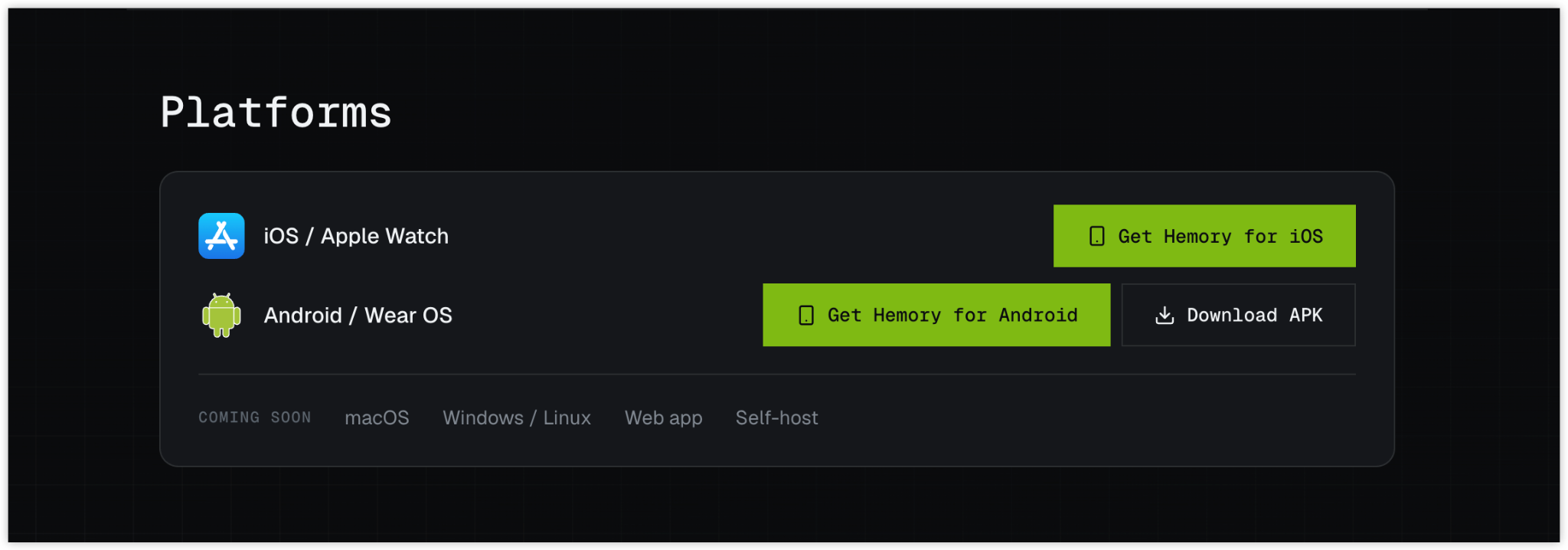
See the mobile and wearable platforms listed on the site.
When a dedicated conversation-capture tool is worth considering
A dedicated tool is most relevant when you want more than a single recording: you want spoken ideas or discussions to become organized records that you can revisit. Hemory is one example. During a listening session, it produces a timestamped transcript with speaker labels and AI cleanup, then classifies daily content into activity types with summaries suited to the activity. Its built-in Q&A supports multi-turn questions about transcript-based Memory and retrieval across different conversation sessions.

Find individual statements in a searchable transcript.
You control when listening starts. Manual Mode lets you start and stop it yourself; Schedule Mode provides reminders with one-tap start and stop actions. The captured history can support later recall without requiring you to decide, while you are speaking, which details might matter. It cannot retrieve an exchange that was never captured, and you should review results before relying on them.

Set listening times for weekdays and weekends.
That makes a dedicated capture tool a possible fit when you regularly return to spoken ideas or conversations. It may be more than you need for an occasional reminder, and you should still evaluate its storage, consent, retrieval, and device behavior against your own requirements.
Make a conditional choice
Use your most common situation to narrow the options:
- Choose a voice recorder if you mainly need a quick, controllable place to leave a one-off thought and can handle any later transcription or organization yourself.
- Choose an AI chat voice mode if your main goal is to speak with an AI immediately. Check what it saves and whether the conversation will be available for later work.
- Consider a dedicated capture tool if preserving and finding spoken ideas or real-world conversations is part of an ongoing workflow. Evaluate what it captures, how you control listening, and how you can retrieve the resulting records.
Before committing, run a small trial using a typical idea or discussion. Confirm that you can start and stop capture as expected, locate the resulting record, and use it in the next step you care about. The best fit is the one that preserves the information you need with controls and access you are comfortable using.
FAQ
Is dictating into an AI chat the same as recording a brain dump?
Not necessarily. Dictation may turn speech into text, while a voice mode may also let you interact with the AI. What is retained and what you can revisit later depend on the specific tool and its settings. Check whether it saves audio, a transcript, or only the conversation result.
Should I keep the audio or just the transcript?
Keep whichever record serves your purpose and fits your storage and privacy needs. Audio may help when you need to hear delivery or revisit an unclear phrase; text can be easier to search and reuse. Confirm that the tool actually retains the format you want.
Do I need a dedicated tool for personal voice notes?
No. If you only need an occasional reminder, a recorder or another simple method may be enough. A dedicated capture tool is more relevant when you expect to organize and revisit spoken ideas or conversations over time.
Can a capture tool recover an idea I never recorded?
No. Retrieval depends on information that was captured and is accessible to the tool. If a detail is missing, use another record or ask someone who was present rather than treating a failed search as proof that the idea was never discussed.