

 Hemory Team
On this page
You remember discussing the launch plan last month, but not whether the team settled on a date or only floated one. If the details live in incomplete notes or a conversation you cannot search, choosing an app that remembers conversations may help. Compare options by what they capture, how they find details across sessions, what evidence they show, and which devices they support. No app can retrieve an exchange it never captured or cannot access.
TL;DR
- Check that the app captures the conversations you want to revisit; searchable results depend on captured, accessible records.
- Test whether it can search across separate sessions and return useful source context—not just a plausible-sounding answer.
- Confirm device support and any relevant history or retention limits before relying on it to find a specific past conversation.
Start with the conversations you need to find
Be specific about the job. Are you trying to recall a decision, find who raised an idea, revisit a useful explanation, or check whether a date was agreed? These needs call for more than a general promise to “remember.”
List the kinds of conversations and details that matter, where those conversations happen, and how long you may need to look back. An app that only handles meetings may not suit someone who also wants to retrieve details from informal work discussions. A tool that only searches one session may not help when the answer is spread across conversations.
Also check what the app can actually capture. Some tools depend on notes or documents you add; others can create transcripts from listening sessions. Neither approach automatically covers every conversation. Check how capture starts and whether the relevant devices and situations are supported.
Compare apps on the criteria that affect recall
| Criterion | What to find out | Why it matters |
|---|---|---|
| Capture | Which conversations can be recorded or added, and how capture starts | A search feature cannot find an exchange that was never captured. |
| Search scope | Whether you can search one session, multiple sessions, or a defined history | Your question may depend on details mentioned in different conversations. |
| Result context | Whether results show transcript lines, summaries, dates, or other source details | Context helps you understand what was said and avoid treating a short answer as the whole story. |
| Review options | Whether you can inspect the underlying record when wording or attribution matters | A transcript or summary is useful evidence, but can still be incomplete or inaccurate. |
| Device support | Which platforms are available now, not merely planned | The app has to work where you need to capture or retrieve conversations. |
| Access and history | Which records the app or connected feature can reach, and whether the history covers your timeframe | “Search across conversations” does not by itself establish that last month’s specific conversation remains accessible. |
1. Check how conversations get into the app
Ask whether the app captures new conversations, accepts material you provide, or relies on another source. Then check the practical steps: Do you start listening yourself? Does the app remind you to start? Does it create a transcript or only a summary? Which devices can do this today?
For Hemory, listening starts through a user action: Manual Mode or a scheduled reminder with one-tap start and stop. Its product information describes timestamped transcripts with speaker labels and AI cleanup. Hemory cannot reconstruct a conversation that was not captured, and transcription is not a guarantee that every word or speaker is represented perfectly.
2. Test retrieval across sessions
A useful test is a question whose answer you know is in a captured conversation—for example, “What concern did we raise about the launch date?” Then try a follow-up that needs another detail from the same or a different session. Notice whether the result is specific, whether it distinguishes a proposal from an agreed decision, and whether it gives you enough source context to review.
Hemory’s built-in Q&A supports multi-turn, transcript-based questions and retrieval across different captured sessions. That makes it relevant to cross-session recall, but it is not a guarantee that every past exchange will be found. The available product information does not establish a guaranteed age or retention window for a particular conversation. If finding last month’s record is essential, confirm that the record is still accessible through the route you plan to use.

Retrieve past commitments and draft follow-up tasks.
For a connected AI agent, check what that specific connection can access. A listed integration does not by itself establish that every agent has the same tools, permissions, or search scope.

Review MCP connection options and access settings.
3. Review the source, not only the answer
A short answer can omit a condition or make a suggestion sound like a decision. When the distinction affects what you do next, inspect the available transcript or source detail. Consider who said it, what they meant, whether anyone accepted the proposal, and whether later information changed the situation.

Find individual statements in a searchable transcript.
You do not need to replay or inspect every conversation for every lookup. Review the source when attribution, wording, a condition, or the current status could change your action. If the record is unclear or missing, use another source or ask a focused follow-up rather than treating a failed search as proof that the conversation never happened.
4. Confirm platform fit and practical limits
Check the current platform list against the devices you actually use. Hemory’s current product information lists iOS, Apple Watch, Android, and Wear OS as supported. macOS, Windows/Linux, the web app, and self-hosting are listed as coming soon, not generally available. If a particular device is essential, confirm its current availability before choosing.
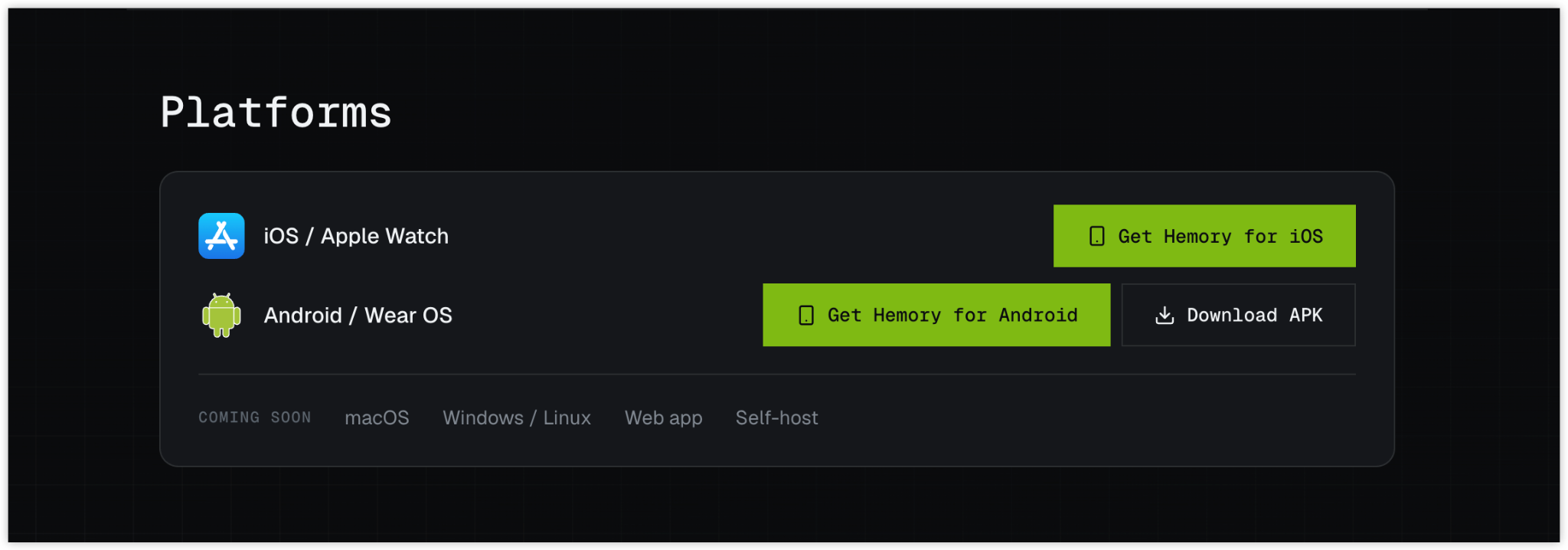
See the mobile and wearable platforms listed on the site.
Also check limits that could affect your use: capture availability, access to older records, plan constraints, and the steps needed to retrieve an answer. Do not assume that a tool’s broad description guarantees a particular session can be found or that every connected client can access the same history.
Make a conditional choice
A conversation-memory app is worth considering when you regularly need details from real conversations, the app can capture those conversations on your devices, and its search reaches the records you need. Prioritize source context and review options when you use retrieved information to make decisions or follow up with other people.
If your conversations already live in a searchable CRM, notes app, or transcript archive, compare those tools first. They may meet the need without another capture workflow. If you mainly need a one-time reminder, a focused note may be simpler. If you want to search across captured conversations and ask follow-up questions, Hemory is one option to evaluate—after confirming the history and platform access relevant to your use.
FAQ
Can an app find a conversation from last month?
Only if the conversation was captured and remains accessible to the search feature you use. Check the app’s history and access scope rather than assuming that cross-session search guarantees a particular time range.
Can conversation search tell me whether something was agreed?
It can help you find what was said, but you still need to interpret the exchange. A suggestion, an accepted decision, and a commitment are different; review source context when that distinction matters.
Do I need to read every transcript?
No. Start with a focused question and review the source when the answer could affect an action, attribution, condition, or decision. A transcript or summary can help, but it is not guaranteed to be complete or error-free.
What should I do if search finds nothing?
A missing result does not prove that the conversation never happened. Check whether it was captured, whether the selected tool can access it, and whether another record contains the detail. If the evidence remains unavailable, ask a focused clarification.
Start with one real question you want to answer from last month. Compare the apps against that captured conversation, inspect the context behind the result, and confirm that your device and history are supported. That gives you a practical basis for choosing without relying on a promise of perfect recall.