

 Hemory Team
On this page
Spontaneous ideas and useful conversations rarely arrive when you have time to organize them. But the quickest way to capture a thought may not be the best way to find it later—or the right choice when other people are involved.
Compare a phone recorder, an AI chat voice mode, and a dedicated conversation-capture tool against the work you need to do before, during, and after speaking. The right choice depends on the moment, the material you need to keep, and how much control you want over capture.
TL;DR
- Choose for the task: a quick voice note, spoken input for an AI conversation, and a record you expect to search later are different needs.
- Check what remains after capture. Audio, a transcript, and an AI-generated summary are not interchangeable.
- Look at start and stop controls, consent practices, retrieval, and device fit before relying on a tool for work conversations.
- A dedicated tool such as Hemory can organize captured sessions into timestamped transcripts and support later questions about captured conversations. It cannot recover a discussion that was never captured.
Start with what you need to capture
A private thought you want to remember puts different demands on a tool than a customer conversation or a brainstorm you may need to revisit. First decide which of these jobs matters most:
- Save a quick idea: You want to record a thought with little setup and may only need to listen to it once.
- Speak an instruction to AI: You want to dictate a prompt or question and use the resulting chat, rather than maintain a separate record of the spoken input.
- Keep a useful conversation record: You want to revisit what was discussed, find a detail, or use captured context in later work.
One tool may serve more than one job, but don’t assume that capturing speech automatically creates a searchable record—or that a saved chat contains the original audio.
Compare the options against the same criteria
| Criterion | Phone voice recorder | AI chat voice mode | Dedicated conversation-capture tool |
|---|---|---|---|
| Effort to start | Often handy for a quick recording; check the steps and controls on your device. | Convenient when you are already working in the chat; setup and behavior vary by service. | Designed for repeated capture, but check how listening is started and stopped on the devices you use. |
| What you can revisit | May preserve an audio file. Transcription, organization, and search depend on the app. | May retain a chat, a transcript, or another representation of the exchange. Confirm whether the original audio is available. | May organize captured sessions into transcripts or summaries. Check which source material is retained and how you can revisit it. |
| Finding a detail later | You may need to replay the recording or create your own notes. | Chat history may help if the relevant content is retained and easy to locate. | Search or question-answering features may help retrieve details from captured sessions; check their actual scope. |
| Control and consent | Check whether you start and stop recording yourself and how the app signals it is recording. | Check when voice capture begins, what is processed or saved, and what controls are available. | Check whether capture is user-started or scheduled, what action begins listening, and how to stop it. For conversations, consider participant awareness and applicable consent requirements. |
| Device fit | Consider the device you already carry and where recordings are stored. | Consider where you use the chat and whether voice input works on those devices. | Confirm that your preferred phone or wearable is supported; do not assume every platform is available. |
Treat the table as a set of questions, not promises about every product in a category. Features differ by app, device, settings, and service. Verify the behavior that matters to your use case.
Check what “saved” actually means
Before choosing, distinguish three possible records:
- Audio: Can you replay the original recording later? Where is it stored, and can you access it from the device you use for review?
- Transcript: Is spoken content converted into text? Can you search or revisit individual passages, and can you return to the corresponding source when needed?
- Summary or chat: Is the saved material an AI-generated interpretation, a chat response, or a summary? These can be useful, but they are not the same as the original speech or a transcript.
A transcript can make spoken material easier to scan, but it is not guaranteed to be complete or error-free. For consequential details, review the available source and check wording or attribution when they affect what you will do next.
Hemory is one example of a dedicated conversation-capture tool. Its product information describes timestamped transcripts, speaker labels, and transcript-line playback on the listening device. Its built-in Q&A can answer questions about a user’s captured Memory across conversation sessions. These capabilities support later review; they do not guarantee that every exchange was captured or that every detail will be found.

Find individual statements in a searchable transcript.
Evaluate control before capturing conversations
A quick voice note to yourself and a conversation involving other people have different consent considerations. Before using any recording method in a meeting or customer discussion, understand how capture is indicated, who is aware of it, and what rules apply in your setting. Do not assume a tool’s convenience settles those questions.
Also check the difference between a reminder and automatic recording. For example, Hemory describes a Manual Mode in which the user starts and stops listening, and a Schedule Mode that provides reminders with one-tap start and stop actions. A reminder is not the same as a tool starting the microphone without user action. Choose a mode that gives you the control you need, and explain the practice to participants when appropriate.
Match the tool to your device and routine
A capture method only helps if it fits where the thought or conversation happens. Check the device you will actually carry, whether capture can begin promptly, and where you will review the result. If you expect to move between a phone and a wearable, verify support for those specific devices rather than inferring it from a product’s general availability.
Hemory currently lists iOS, Apple Watch, Android, and Wear OS as supported platforms. Its product information lists macOS, Windows/Linux, Web, and self-hosting as coming soon, not currently available. Confirm current support for your device before making it part of a routine.
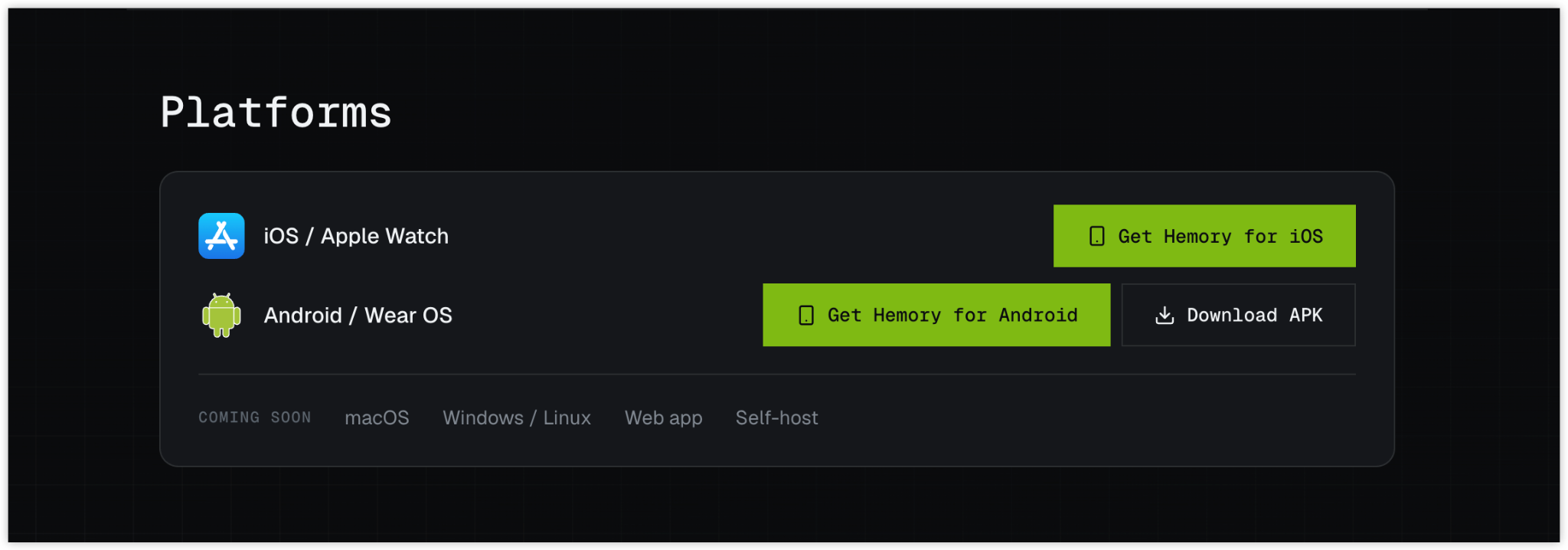
See the mobile and wearable platforms listed on the site.
Use a short evaluation checklist
Before settling on an approach, answer these questions for the specific tool and device:
- Can I start and stop capture at the moment I need it?
- What exactly can I access afterward: audio, transcript, summary, chat, or some combination?
- Can I find a detail later without replaying or re-entering everything?
- Do I understand the capture indicator, storage, and controls well enough for the setting where I’ll use it?
- Does it work on the device I have with me, and can I review the material where I need it?
- If I use an AI assistant with captured context, can that connection access the relevant material, and what will I need to review myself?
Try the method on a low-stakes idea or an appropriate conversation before depending on it for important work. Check whether the saved result contains enough detail for your next step. If you cannot locate a key point or tell what source it came from, adjust the method or choose a tool with a better fit.
Which approach should you choose?
Use a phone recorder when you mainly need a simple way to save audio and are comfortable reviewing or organizing it yourself. Use an AI chat voice mode when your main goal is to speak into an AI interaction and the saved chat or output is enough for your purpose. Consider a dedicated conversation-capture tool when you regularly need to preserve and revisit spoken ideas or discussions, and its controls, source material, and device support fit your needs.
There is no universal winner. Choose based on the record you need afterward, how you want to control capture, and the devices and consent practices your work requires. If you try Hemory, begin with a conversation or voice note you are comfortable capturing, then see whether its transcript and retrieval capabilities support the way you need to revisit that material.
FAQ
Is dictating into an AI chat the same as recording a voice note?
No. Dictation may be intended to supply an AI chat, while a voice note is intended to preserve something for later. What the service retains—audio, text, chat, or another result—depends on its implementation and settings.
Should I keep the audio or a transcript?
It depends on what you need to do later. Audio lets you replay a recording; a transcript can be easier to scan and search. A summary can be useful for orientation but may omit detail. Check which forms are retained and accessible before relying on them.
Can a dedicated capture tool find a conversation I never recorded?
No. Retrieval can only use information that was captured and is accessible through the tool or connection you use. If a needed detail is missing, consult another source or ask someone who was involved.
What should I check before recording a work conversation?
Check the tool’s controls and recording behavior, make participants appropriately aware, and follow the consent requirements that apply to your situation. A tool’s start or stop controls do not replace those responsibilities.