

 Hemory Team
On this page
A useful idea can arrive halfway through a walk, when stopping to type would break your train of thought. For a single thought, a short voice memo may be enough. If the idea is part of a longer conversation you want to revisit, a listening session may fit better. Choose the method that is easy to start safely and gives you a useful record afterward.
TL;DR
- For one passing thought, use a voice memo if you can start and stop it safely without distraction.
- Say the idea and one useful clue—such as why it matters or what to do next—so it makes sense later.
- Hemory captures user-started listening sessions, not a dedicated one-off dictation. Its timestamped transcripts and organized Memory can help preserve ideas in the context of a broader session.
Choose the capture method that fits the thought
| What you need to keep | A practical option | What to expect later |
|---|---|---|
| One brief idea, separate from a conversation | A voice memo or recorder you already know how to use | A short recording to replay. Add a spoken clue so you can recognize why it mattered. |
| An idea that comes up during a discussion or a session you want to preserve | Hemory listening, started by you on a supported device | A timestamped transcript and organized Memory from the listening session. |
| A thought you cannot safely record right then | Wait until you are somewhere safe, then record a quick recap or type a few words | A later recap preserves your recollection; it is not the original moment or another person’s exact words. |
The simplest choice is often the one you can use safely and reliably in that moment. Do not handle a device while crossing a street or navigating a crowded area. If starting a recorder would distract you, wait until you can stop safely.
Make the spoken idea easy to understand later
You do not need to dictate a polished note. Give the recording enough context to help you recognize the thought when you return to it. For example:
“Idea for the onboarding guide: explain the handoff between setup and the first team check-in. I want to sketch an example tomorrow.”
A short capture can include three things:
- The idea: What occurred to you?
- A clue: What project, person, or situation does it relate to?
- A possible next step: Is there something you want to do with it later?
Treat the next step as a reminder to yourself, not as a commitment someone else has agreed to. If you are not sure what to do with the thought yet, just capture the idea and its context.
When Hemory is a better fit
Hemory is designed around listening sessions you start and stop, rather than a dedicated voice-memo or dictation workflow. Its documented platforms are iOS, Apple Watch, Android, and Wear OS. In Manual Mode, you control listening directly. Schedule Mode can remind you at a set time and offers one-tap start and stop actions; it does not silently start recording for you.
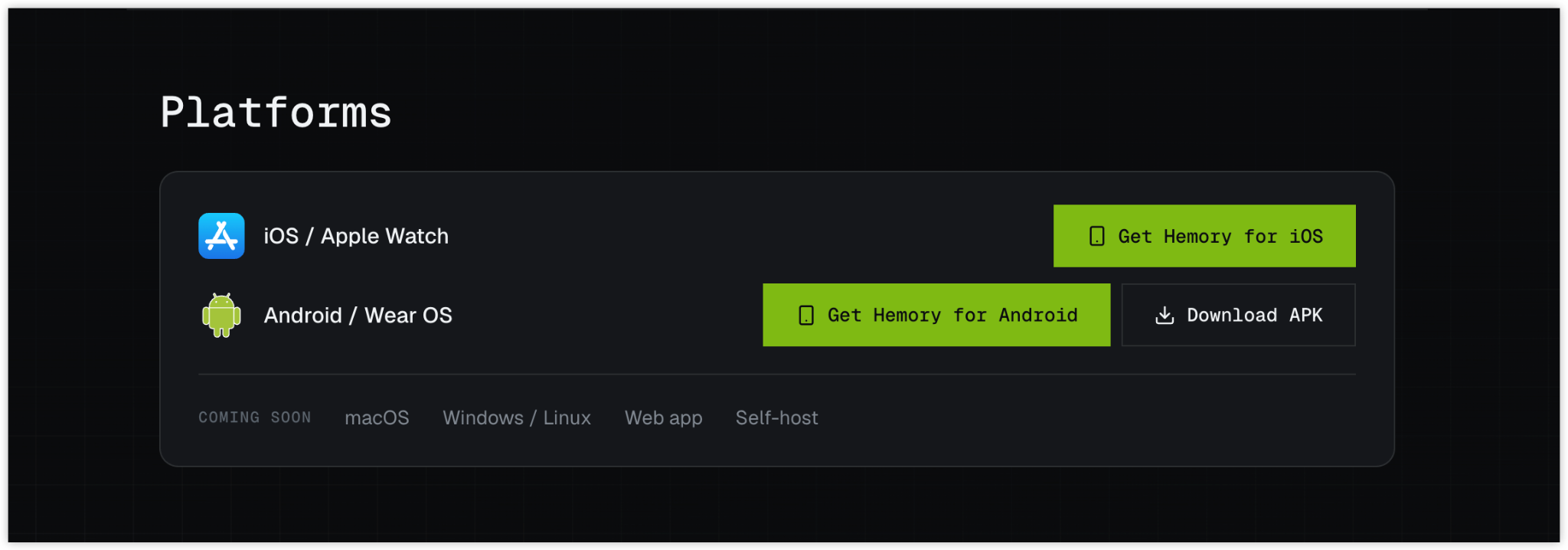
See the mobile and wearable platforms listed on the site.
That makes Hemory more relevant when the spoken idea belongs with a meeting, brainstorming session, or other conversation you want to revisit—not necessarily when you only need to save one isolated sentence. A listening session produces a timestamped transcript, and Hemory organizes captured Memory. Later, you can use its built-in Q&A to ask about your Memory across conversations. The conversation must have been captured; Hemory cannot retrieve an idea it never recorded. The product information does not establish how quickly a new transcript becomes available, so do not rely on immediate retrieval.
If you are already planning to start a session, you can say the idea aloud as it comes up rather than trying to write it down mid-discussion. If you only need a quick standalone memo, use a recorder that already suits that task instead. Either way, review the result before treating a remembered detail as an exact quote or a confirmed decision.
A simple routine for a passing thought
- Choose a safe moment. Keep walking without using your device if stopping or operating it would distract you.
- Start the method that fits. Use a voice memo for one isolated thought. Start a Hemory listening session when you want to preserve a broader conversation or session.
- Speak naturally. State the idea and one clue that will help you recognize it later. Do not force a full explanation while the thought is fresh.
- Return to it when useful. Replay the memo, or review the relevant captured session in Hemory. Use the transcript and available Q&A as aids, then apply your own judgment about what the idea means and whether it calls for action.
A good capture is not necessarily a complete plan. It is a record that gives you enough to decide later whether the thought is worth developing.