

 Hemory Team
On this page
Colleagues may object to a bot joining external calls, but removing the bot does not resolve the practical questions: which conversations will still be captured, who controls recording, and where the resulting records go? Use this checklist to gather answers from your organization and vendors before changing the team’s setup.
TL;DR
- Check coverage in the actual devices, meeting environments, and call types your team uses; do not assume a botless method captures every call.
- Confirm who can start and stop capture, what participants are told, and which internal policies or rules apply.
- Map where recordings, transcripts, and summaries are stored, who can access them, and how long they are kept.
- Decide what happens to existing recordings separately from how new calls will be captured.
- Test the proposed setup against representative calls before rolling it out.
Questions to answer before switching
1. Which calls and devices will the new method cover?
List the team’s common call types, devices, and working conditions. Then confirm what the proposed method can capture in each case. Ask about interruptions, device changes, connectivity, and whether capture can continue when the user is away from their primary computer.
Do not infer that a recorder works with a meeting platform just because it can capture audio nearby. Ask the vendor to demonstrate the specific setup you plan to use, and check your organization’s rules for those calls. Record any uncovered situation and decide whether the team needs another approved method or should leave that call unrecorded.
If Hemory is one candidate, its supplied Features page lists iOS and Apple Watch and describes Manual Mode and scheduled reminders with one-tap start and stop. Verify that the relevant device and call setup meet your needs; those descriptions do not establish coverage for every meeting platform or permission to record a particular call.
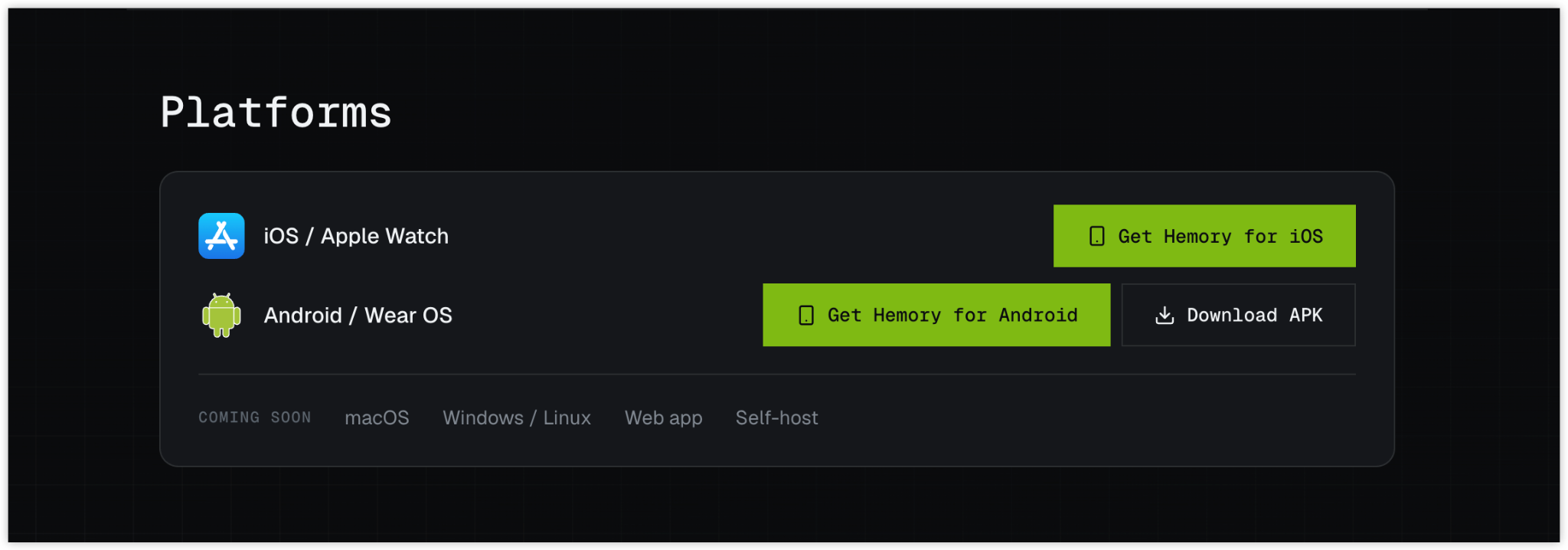
See the mobile and wearable platforms listed on the site.
2. Who can start, stop, and manage a recording?
Ask who is authorized to initiate capture, whether the person needs to take an explicit action, and how they can tell that recording is active. Confirm how the process works if the designated host is absent or the call starts unexpectedly.
Also agree on what participants are told and when. Have your security, privacy, or legal contacts determine which consent, notice, and policy requirements apply to your organization and the calls involved. A recorder that does not add a meeting bot may still capture conversation, so “botless” should not be treated as “no recording” or as an automatic policy exception.
3. Where do recordings and other artifacts go?
Ask the vendor and your internal system owners to map each output separately: original audio, transcript, summary, and any notes or action items. For each one, establish:
- Where it is stored and whether it is copied or synced elsewhere.
- Who can access it, including administrators or connected services.
- How access is granted and revoked.
- How long it is retained and what deletion removes.
- Whether records can be exported, transferred, or retrieved later.
Do not treat “recording stored on a device” as an answer about transcripts, summaries, or every other type of data. If the vendor’s documentation does not answer a question, keep it open for review rather than assuming the most favorable interpretation.
4. Which security and device rules apply?
Ask your security or IT team to review the actual capture path, devices, accounts, storage locations, and integrations. Check whether company-managed devices are required, whether personal devices are allowed, and what happens when a device is lost, replaced, or shared.
Include any rules specific to external calls, confidential information, customer records, or regulated work. Your organization should decide whether the proposed method meets its requirements; a vendor feature description alone cannot settle that decision.
5. What happens to existing recordings?
Treat the archive as a separate workstream from future capture. Decide whether existing records will remain in the current tool, be exported or migrated, or be deleted under an approved process. Before moving anything, confirm whether export and import are supported, which fields and attachments survive, who may access the destination, and whether retention or deletion rules change.
If records are kept in more than one place during a transition, identify which location the team should use and how long the overlap will last. A plan to move recordings is not confirmation that they have been transferred, checked, or removed from the original system.
Pilot the proposed setup before rollout
Use a small, representative set of calls to check the answers in practice. Include the devices and call conditions that matter to the team, then confirm that capture starts as intended, participants receive the required notice, records land in the expected locations, and authorized users can find and use them.
Write down failures and uncovered cases. Proceed only when the team has resolved the issues that affect policy, access, or essential coverage—or has agreed on a workable fallback. Do not use a successful test on one device or call type to claim universal coverage.
FAQ
Does removing the meeting bot mean the call is not recorded?
No. A different method may still capture audio or produce records. Confirm when capture occurs, how participants are informed, and which organizational rules apply.
Can I assume a botless recorder works with every video-call platform?
No. Verify the exact device, call type, and setup you intend to use. A general capture feature does not prove compatibility with every platform or permission to record every call.
Should we migrate all old recordings when we switch?
Not automatically. Decide whether to retain, migrate, export, or delete existing records based on their purpose, access, retention requirements, and the verified capabilities of both systems.
Next step
Use the checklist to collect written answers from your security and IT teams and the vendors involved. Start with the calls and devices that matter most, then pilot the agreed setup before changing the whole team’s workflow.