

 Hemory Team
On this page
A wearable recorder can make conversation capture feel convenient: it is close at hand, rather than something you remember to open on your phone. But the device is only one part of the decision. You also need to understand when it captures, what happens to the recording, and whether its output will be useful later.
TL;DR
- An AI wearable recorder combines a wearable capture device with software that may transcribe, summarize, or help retrieve conversations. Features differ by product.
- The hardware adds a device to wear, charge, connect, and keep track of. Consider whether that burden fits your routine.
- Before relying on one, ask about capture controls, consent, data handling, battery, transcription limits, access, and how to retrieve or reuse the result.
- You do not need a dedicated wearable to explore conversation memory. Hemory supports listed platforms including iOS, Apple Watch, Android, and Wear OS; that does not imply compatibility with every separate recorder or identical capture behavior on every platform.
What is an AI wearable recorder?
An AI wearable recorder is a device worn on the body that captures nearby speech and pairs that capture with software features. Depending on the product, those features may include transcription, summaries, speaker labels, search, or question answering. Do not assume every device offers all of them, or that a feature works the same way across products.
The category combines two things that are worth evaluating separately:
| Layer | What to understand |
|---|---|
| Capture hardware | Where the device is worn, how it starts and stops recording, what it needs to connect, and how often it needs charging. |
| Software and service | Whether speech is transcribed or summarized, where captured material is stored, how it can be found, and whether it can be used in later work. |
A recording is not automatically a useful record. Transcripts can contain errors or omissions, and a short summary may leave out a condition or explanation that matters later. Ask what the tool produces and whether you can review or retrieve the underlying material when needed.
What does the wearable hardware add?
The main trade-off is convenience versus an additional device to manage. A wearable may be easier to have nearby than a phone you would otherwise need to take out. It also adds practical questions: Will it be comfortable in the situations where you want to capture conversations? Will you remember to charge and bring it? Does it need a phone or network connection? What happens if it is not charged, connected, or available?
Treat battery claims as specific to the device, settings, and use described by its maker. A figure for one model or listening mode does not establish how long another device will last in your routine. Ask what the stated battery estimate assumes, and consider your typical day rather than an idealized maximum.
Also consider whether you need a new device at all. If your main goal is to preserve conversations for later reference, first check whether a phone, watch, meeting tool, or note system you already use can support the capture and retrieval you need. The right comparison is not simply wearable versus no recording; it is whether the full workflow is useful enough to justify the extra hardware and upkeep.
What should you ask before relying on one?
Use these questions to assess a specific device. Look for clear answers in its current product documentation and settings; do not infer them from the word “AI” or from a short demonstration.
When does it capture, and how do I control it?
Ask how recording starts and stops, whether you must take an action to begin, and what indicates that capture is active. Find out whether controls differ between modes or platforms. Confirm what happens when the device loses power or connectivity. Do not assume a scheduled setting means silent or automatic recording.

Set listening times for weekdays and weekends.
What consent and privacy steps are needed?
Consider who may be recorded and what notice or consent is appropriate in your setting. Requirements vary by location and situation, so a device feature cannot settle the legal or workplace question for you. Ask how the device makes recording visible and what guidance the provider gives for recording other people.
What happens to audio, transcripts, and summaries?
Ask separately where raw audio, transcripts, and generated summaries are processed and stored; how long each is retained; who can access it; and what deletion removes. These are different kinds of data, so a statement about audio alone does not answer what happens to transcripts or summaries. If the conversations contain sensitive information, resolve those details before making the device part of your routine.
How dependable is the record for the task I have in mind?
Ask which languages and recording conditions are supported and how the product handles speaker labels or unclear speech. Treat a transcript as a record of captured speech, not guaranteed ground truth. For a consequential follow-up, review the relevant passage and clarify anything missing or ambiguous before acting.
Can I find and reuse what I capture?
Ask whether you can search across past conversations, retrieve the surrounding explanation, and export or share useful material. Check whether the result can reach the next place you work, or whether you will need to copy it manually. A transcript that is difficult to locate may not solve a later-recall problem.
Hemory is one separate conversation-memory option, rather than a compatibility layer for every wearable recorder. Its current listed platforms include iOS, Apple Watch, Android, and Wear OS; macOS, Windows/Linux, the Web app, and Self-host are listed as coming soon, not generally available. Check the exact capture workflow for the platform you plan to use. Hemory organizes captured conversations for later retrieval, but its platform list does not establish support for a third-party recorder.
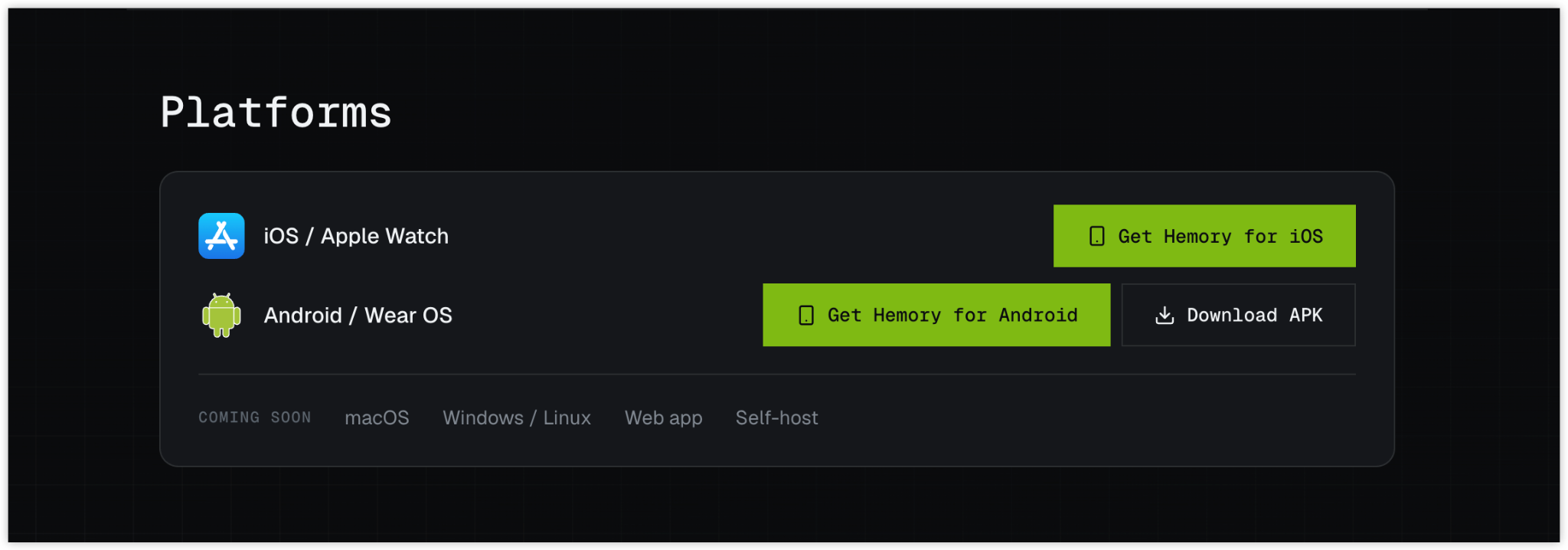
See the mobile and wearable platforms listed on the site.
How to decide whether the category fits
Start with the work you want the captured conversation to support. If you only need an occasional reminder, a brief note may be enough. If you need to revisit explanations, decisions, or details across conversations, prioritize reliable retrieval and clear data handling alongside capture convenience.
Then check the practical fit:
- Capture: Can you start and stop it in the situations that matter, with clear control and appropriate notice?
- Routine: Will you wear, charge, and maintain the device consistently?
- Record quality: Can you review the transcript or other output when accuracy matters?
- Data handling: Are storage, retention, access, and deletion clear for each relevant data type?
- Reuse: Can you find and carry the necessary context into the next task without excessive manual work?
A wearable is a reasonable candidate when its capture method fits your routine and its data and retrieval behavior meet your needs. If you cannot get clear answers about consent, control, or data handling, do not rely on convenience alone to make the decision.
FAQ
Is an AI wearable recorder the same as a voice recorder?
Not necessarily. A voice recorder captures audio; an AI wearable recorder pairs wearable capture with software that may transcribe, summarize, or support retrieval. The exact capabilities vary, so check what a specific product actually provides.
Do I need a wearable to keep conversation records?
No. A phone, watch, meeting tool, or another supported method may fit your needs. Compare the capture process, privacy practices, and ability to find and reuse the result—not just the form factor.
Does a transcript prove exactly what happened?
No. A transcript records recognized speech and may contain errors or omissions. Check consequential details against the available record and seek clarification when needed.
Choose for the whole workflow
Before buying, trace one real use case from capture through later retrieval: when you would record, what information you need to keep, how you would find it, and what you would do with it. That makes the trade-off concrete: a wearable may reduce the effort of getting a recorder to hand, while adding charging, privacy, and device-management responsibilities. Choose it only if that full workflow fits your needs.