

 Hemory Team
On this page
A wearable recorder can make it easier to capture a conversation without holding a phone or taking notes throughout. But the label “AI recorder” does not tell you when it records, what happens to the captured material, or whether you can use that material later. Before buying, evaluate the whole path from capture to retrieval—not just the device’s size or advertised AI features.
TL;DR
- Treat an AI wearable recorder as a capture-and-software workflow. Transcription, summaries, search, and later AI use vary by product.
- Check recording controls, battery and interruption behavior, consent practices, and what happens to audio, transcripts, and summaries.
- Decide how you will retrieve, export, or reuse the material after capture. A recording that cannot support your next task may add storage and review work without solving the problem.
- Hemory is one option for capturing and organizing conversations on its listed supported platforms, including Apple Watch and Wear OS. Check support for your specific device and setup; do not assume every wearable is compatible.
What is an AI wearable recorder?
An AI wearable recorder combines a device worn on the body with software that captures speech and may turn it into other forms of information. Depending on the product, that might include a transcript, a summary, speaker labels, search, or answers based on captured conversations. These are separate capabilities: a product may record without offering useful search, or create summaries without making the underlying discussion easy to retrieve.
The wearable changes how capture happens; it does not automatically make the resulting information complete, accurate, private, or useful. Treat the device, its companion software, and any connected AI service as parts of one workflow. Ask what each part does and where your captured material goes.
What extra hardware burden does a wearable add?
A dedicated wearable can reduce the need to hold or place a phone during a conversation, but it creates another device dependency. Consider the practical costs alongside any convenience:
- Charging and battery: Find out how long the device lasts under the listening pattern you expect, how recording affects battery use, and what happens when the battery runs low. Published figures may depend on a specific model or test condition, so compare like with like.
- Wearing and carrying it: Check whether the device is comfortable, discreet enough for appropriate use, and practical to bring to the places where you want to capture conversations. A device left at home cannot capture anything.
- Starting, stopping, and interruptions: Learn how listening begins and ends. Ask what happens during calls, meetings, low-connectivity periods, or other interruptions, and whether you can tell when capture is active.
- Compatibility and upkeep: Confirm that the exact device, operating system, app, and account setup you plan to use are supported. Consider updates, setup, syncing, and what you would do if the wearable is unavailable.
- Review effort: Capturing more material can also mean more material to organize and review. Ask how the product distinguishes different kinds of activity and how you will find the parts that matter later.
If your phone already captures the conversations you need, compare that workflow with the wearable rather than assuming an additional device will improve it. The right choice depends on where you work, how you can capture responsibly, and whether the wearable removes a real obstacle.
What should you ask about privacy and consent?
Do not infer privacy practices from a device’s appearance, the word “local,” or a general claim that it uses AI. Ask about each kind of data separately and look for clear, current answers:
- When is audio captured? Can you see or hear when listening is active? What action starts and stops it? Are any scheduled modes reminders that require you to start listening, or do they operate differently?
- Who may be recorded? What notice or consent is appropriate for your setting? Check your organization’s policies and the rules that apply where the conversation takes place. Do not assume that wearing a small recorder makes recording acceptable.
- What happens to the audio? Ask whether raw audio is stored, where it is processed, how long it is kept, and what deletion does. Do not treat answers about audio as answers about transcripts or other records.
- What happens to transcripts and summaries? Ask where they are stored, who can access them, how long they remain available, and whether they are used for purposes beyond providing the service. Check how deletion works for each type of record.
- What changes when AI features or integrations are used? Find out which information is sent to a connected service, what the connection can access, and whether it can take actions outside the recorder. A connection does not by itself establish the same permissions or behavior across every AI client.
If a provider does not clearly explain a practice that matters to your work, treat it as unresolved. Do not record sensitive conversations on the assumption that an unanswered privacy question will be harmless.
Will the captured material help with later work?
A transcript or summary is not automatically a useful memory system. Before choosing a device, name one or two tasks you expect to do after a conversation: for example, recall a decision, find a condition attached to a proposal, or prepare a follow-up. Then ask whether the product can help you get from capture to that result.
Consider whether you can search across the conversations you have captured, distinguish one discussion from another, and review enough surrounding context to interpret a result. A summary may be a useful starting point, but it may leave out a qualification or change in status. A transcript preserves a record of speech, not guaranteed truth or perfect transcription. Review consequential details before acting on them.
Also check what can be shared or reused. Can you export a record or provide relevant context to another tool? What does that tool receive, and can colleagues access the material? Do not assume that a link grants access, that a personal archive is shared with a team, or that an AI connection can update your work systems.
For Hemory, the useful question is whether its supported setup fits the way you want to capture and revisit conversations. Its current product information lists iOS, Apple Watch, Android, and Wear OS as supported platforms; macOS, Windows/Linux, the Web app, and self-hosting are listed as coming soon, not generally available. Check the current support information for your exact device and workflow rather than assuming every recorder can connect. Hemory can organize captured conversations and help retrieve relevant context for later work, but it cannot recover an exchange that was never recorded. A supported connected AI agent may use accessible Hemory context to help with a task; the agent’s capabilities and the user’s review remain separate from Hemory’s capture and retrieval.
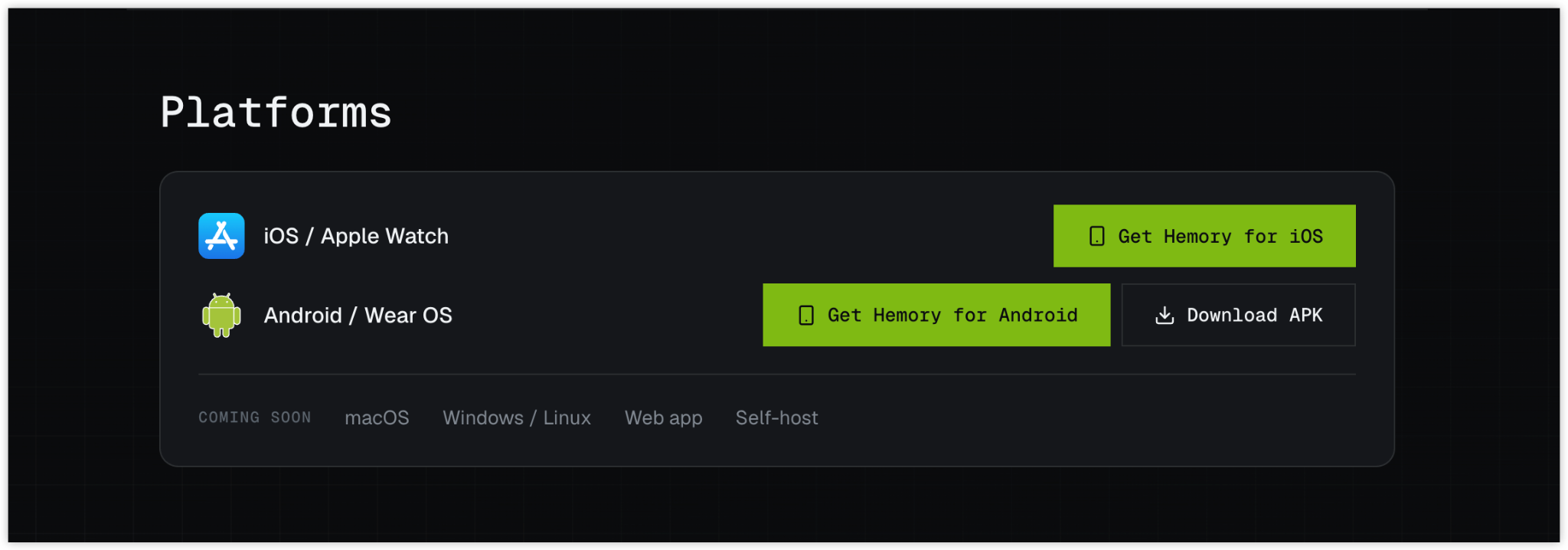
See the mobile and wearable platforms listed on the site.
A short checklist before you buy
Use these questions to compare a wearable with your current capture method:
| Question | What you need to understand |
|---|---|
| What conversations do I need to capture, and where? | Whether a wearable solves a real capture problem in the settings where you work. |
| How do I know listening is active, and how do I stop it? | The practical recording controls and how they fit consent and workplace expectations. |
| What happens when the battery runs low or capture is interrupted? | Whether the device can support your expected routine, including its likely gaps. |
| What happens to audio, transcripts, summaries, and connected-service data? | Storage, processing, access, retention, deletion, and any additional use—by data type. |
| Can I find and reuse the information I care about? | Whether search, context, export, or supported AI access helps with a real task. |
| Is my exact device and setup supported today? | Current compatibility, not a roadmap or a general category claim. |
| What will I do if an important detail is missing or unclear? | A fallback such as checking another record or asking a focused follow-up question. |
You do not need a feature list for its own sake. If a capability does not support a task you actually have, it should not outweigh a clear limitation in privacy, battery, compatibility, or retrieval.
Frequently asked questions
Does an AI wearable recorder capture every conversation clearly?
No recorder should be assumed to capture every exchange completely or transcribe it perfectly. Placement, noise, interruptions, device behavior, and transcription can affect the result. Check important details against available context before relying on them.
Is a wearable recorder more private than recording with a phone?
Not inherently. The form factor does not answer when recording is active, who is captured, how data is processed, or how long records are kept. Compare the actual controls and policies for the full workflow, and follow applicable consent requirements.
Do AI wearable recorders automatically let me search or use conversations with an AI assistant?
Not necessarily. Recording, transcription, cross-conversation search, and access by an AI assistant are distinct capabilities. Confirm which are available, what information the assistant can access, and what it can do with the result.
Can Hemory work with any AI wearable recorder?
Do not assume so. Hemory lists iOS, Apple Watch, Android, and Wear OS as supported platforms, but platform support does not establish compatibility with every device or third-party recorder. Check the current product information for the specific setup you plan to use.
Choose for the workflow, not the label
Before buying, identify the conversation you need to capture and the later task the record should support. Compare the device burden, recording controls, consent practices, data handling, compatibility, and retrieval path against that task. If you already use a supported Hemory setup, organizing and retrieving captured conversations may help reduce later searching and retelling. Whatever you choose, keep a fallback for details that were not captured or cannot be confirmed from the available record.