

 Hemory Team
On this page
A phone can be perfectly practical for a planned meeting and still get in the way during a site walk, a client conversation at a counter, or a quick discussion in a hallway. Taking it out, finding a place for it, and managing the recording can interrupt the conversation or divide your attention. The result may be missed details—or no useful record at all.
TL;DR
- Phone capture may be impractical when handling or displaying the device disrupts the work or changes the feel of the conversation.
- Look for concrete signs: you keep postponing capture, lose track while operating the phone, or leave without details needed for follow-up.
- A wearable may reduce device handling in some situations, but it is not a way to record covertly. Ask permission and use a recording method that is appropriate for the setting.
- Hemory supports listening on Apple Watch. Listening remains user-controlled: Manual Mode starts and stops listening, while Schedule Mode provides reminders with one-tap start and stop actions.
Situations where a phone can get in the way
The issue is usually not the phone itself. It is the mismatch between the device and the conversation: the exchange is moving, your hands are occupied, or placing a phone in view would disrupt the interaction.
| Situation | What makes phone capture awkward | What may be lost |
|---|---|---|
| Client walk-through | You are moving between spaces, pointing out details, or responding to questions instead of staying beside a device. | Explanations tied to a particular location, concern, or next step. |
| Site visit or inspection | Your hands may be occupied, and stopping to handle a phone can interrupt the work. | Context about what was observed and why it matters. |
| Hallway or impromptu discussion | The exchange may be brief, and setting up a phone can make it feel more formal than intended. | A useful idea, clarification, or commitment that is not written down afterward. |
| Conversation in a shared or sensitive setting | A phone placed on the table may draw attention or make participants uncomfortable. | The conversation may stop, become less candid, or remain uncaptured. |
| Fast-moving group discussion | You may be listening, contributing, and keeping track of the phone at the same time. | Conditions, differing views, or details that did not make it into a short note. |
These are signs to assess, not proof that recording is the right choice. Some conversations should not be recorded; others may be better captured with a short note or a follow-up question.
Signs that handling the phone is costing you attention
Notice what happens during and after the conversation. Phone capture may be a poor fit when:
- You repeatedly delay starting because taking out or positioning the phone feels disruptive.
- You split your attention between the discussion and the device, and find it harder to ask questions or respond naturally.
- The conversation moves through a space where a stationary phone cannot stay with the relevant context.
- You leave with only a vague recollection because note-taking or device handling pulled you away from the exchange.
- Important details are missing from the follow-up: what a comment referred to, what condition applied, or what still needs clarification.
The practical cost is not simply an incomplete transcript. It may be the extra work of reconstructing the discussion later—or making a decision without a detail that would have changed your next step. A missing record does not necessarily mean a phone was the problem; the conversation may not have been recorded, the detail may not have been captured clearly, or the point may still need clarification.
When a wearable option may be worth considering
A wearable is worth considering when the main friction is handling a phone, and recording is appropriate with the participants’ knowledge and permission. It may be a better fit for a moving walk-through or a conversation where keeping a phone in hand would interfere with participating.
Hemory supports listening on Apple Watch, which can capture and upload listening content independently. Its Manual Mode lets you start and stop listening; Schedule Mode provides reminders with one-tap start and stop actions. These controls do not mean that a watch records without user action. A wearable also does not guarantee that every speaker or detail will be captured accurately.
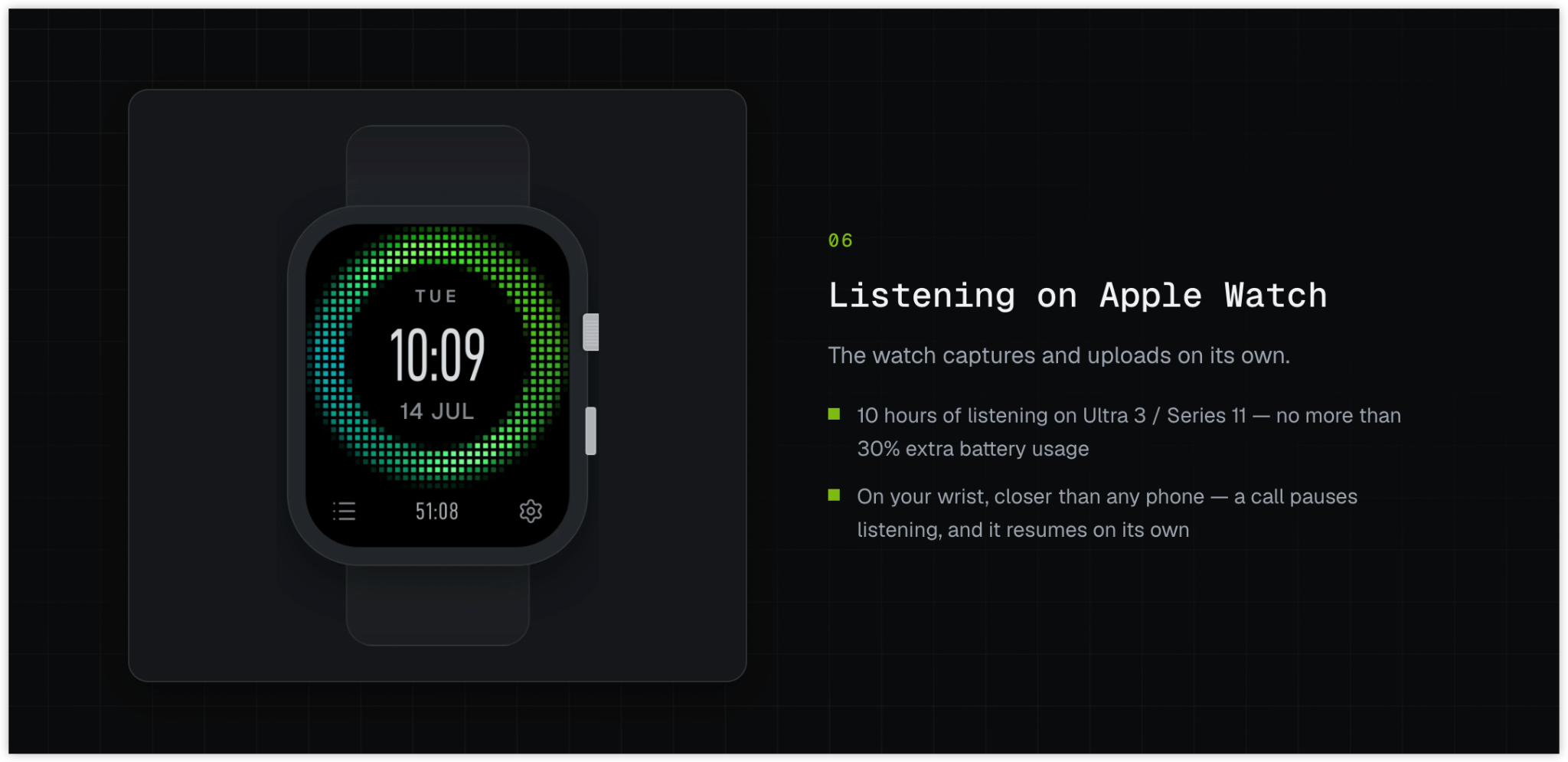
Hemory listening interface shown on Apple Watch.
Before choosing this approach, ask:
- Is recording appropriate here? Get permission and follow the relevant workplace, client, and site rules. If participants are uncomfortable, do not record.
- Is device handling the real obstacle? If the concern is permission, noise, poor audio, or a need to protect sensitive information, changing devices may not solve it.
- Will a wearable let you participate more naturally? The useful test is whether you can stay engaged without adding a different distraction.
- Do you have a suitable supported device and control over listening? Check that the option fits your setup and that you can clearly start and stop it.
If a short written note can preserve the necessary outcome without disrupting the conversation, that may be enough. A wearable is an option for reducing device handling, not a requirement for capturing every exchange.
What a captured conversation can support later
When a conversation is appropriately captured with Hemory, the session can produce a timestamped transcript with speaker labels and AI cleanup. Hemory also classifies daily content by activity type; meeting sessions may receive structured notes, while other activities get summaries suited to their type. These records can help you revisit what was discussed instead of rebuilding the exchange from memory, but they are not a guarantee that nothing was missed or transcribed incorrectly.

Find individual statements in a searchable transcript.
That can matter after a walk-through or informal discussion, when you need to recall the explanation behind an observation or identify a point that needs follow-up. Review consequential details and seek clarification when the record does not establish what was meant or agreed. If the exchange was never captured, use another available source or ask a focused question; a recording tool cannot recover a conversation it did not record.
FAQ
Is a phone always the wrong choice for recording a meeting?
No. A phone can work well when it is easy to place, does not interfere with participation, and recording is appropriate. Consider another approach only when the device creates a real interruption or distraction.
Does using a watch make recording less noticeable?
A wearable may reduce the need to hold or place a phone, but it should not be treated as a way to record without participants’ knowledge. Ask permission and follow the rules that apply to the setting.
Can a wearable capture every detail accurately?
No recording method guarantees complete or error-free capture. Review details that affect decisions or follow-up, and clarify anything the available record leaves uncertain.
Choose the method that lets you take part
If managing a phone repeatedly pulls you out of a conversation, that is a useful signal to reconsider the capture method—not a reason to record every exchange. When recording is appropriate, a user-controlled wearable option such as Hemory on Apple Watch may reduce the need to handle a phone, while captured sessions can provide transcripts and summaries for later review. If permission, access, or clarity is the real concern, address that first.