 Hemory Team
On this page
You are preparing a project handoff when someone asks why the team rejected an earlier option. The project document records the final choice, but not the reason. To finish the handoff, you have to search old notes or ask someone who was there.
Those extra steps take time. Waiting for an answer can delay the handoff; missing the reason can lead someone to repeat work the team has already done. This guide helps you spot those costs and decide where keeping conversations searchable would make a difference.
TL;DR
- Look for four burdens caused by missing information: searching, asking colleagues, repeating work, and waiting for answers.
- Distinguish information that was never captured from information that is buried, outdated, or still undecided. Each calls for a different response.
- Track active effort separately from delays, and exclude discussions that are needed to interpret new information or reach agreement.
- Hemory records and organizes real-world conversations, so you can participate in the discussion and return to its details when a later task needs them.
Four costs to look for
1. Reconstructing the same background
Preparing a proposal, project brief, or follow-up often requires details that did not make it into the final notes. A customer might have explained why a standard workflow would not work for their team. Weeks later, that explanation is needed to write a useful recommendation.
Without a retrievable record, you search messages, compare notes, and piece together what you remember. Before you can write the recommendation, you have to establish what the customer needs and why the standard approach did not fit.
Look for occasions when you already knew something during a conversation but had to recover it before you could use it. That is a more useful signal than the total number of documents or recordings you keep.
2. Interrupting someone to recover a fact
Asking a colleague can be the right choice when you need their judgment. It becomes avoidable retrieval work when you only need a detail they have already explained: the delivery condition, the customer objection, or the reason an option was rejected.
Both people spend time on the exchange. The colleague may also need to reopen their own notes before answering. If the same person repeatedly becomes the route to a project’s history, their availability starts to determine how quickly other work can proceed.
Distinguish “What did we agree?” from “Given what has changed, what should we do now?” A record can often answer the first. The second may still deserve a conversation.
3. Repeating work without the earlier reasoning
A team revisits a proposal because the earlier objection is missing from the handoff. A designer develops an approach that was ruled out after a customer interview. A project lead recreates a comparison because only the chosen option was documented.
The avoidable cost is the work that could have been informed by the earlier discussion. Reconsidering an option after new evidence is different: that may be exactly what the team should do.
When reviewing an instance of rework, ask: would the earlier context have changed the work before it began? If the answer is no, better retrieval might not have prevented it.
4. Waiting for a missing detail before taking the next step
A missing detail can hold up a decision even when recovering it takes little active effort. You send a question in the morning, receive the answer in the afternoon, and finish the handoff afterward.
Keep the waiting time separate from the time spent searching or responding. It helps you understand why a small information gap can disrupt a deadline without pretending that every hour of waiting was an hour of lost labor.
For example, a handoff that waits for a customer constraint may delay the next person’s start. A handoff meeting that explains unfamiliar work and lets the recipient ask questions may be valuable. The issue is repeated reconstruction of existing facts, not the existence of a meeting.
Identify why the information is missing
“We can’t find the conversation” can describe several different problems. Before adding another tool or documentation habit, identify the gap.
| What happened? | What it means | Useful next step |
|---|---|---|
| The detail was discussed but never recorded | There is no dependable record to retrieve | Ask someone involved; capture similar discussions going forward |
| The record exists but is hard to locate | The retrieval process is getting in the way | Search with a person, topic, or approximate date; use a direct question where available |
| You found an older agreement | The record may no longer reflect the current position | Look for the later discussion or confirm the change with its owner |
| People discussed an option without agreeing | The missing decision may never have been made | Resolve the open question instead of searching indefinitely |
If a record already exists, making it easier to find can reduce repeated searching and questions. If useful remarks regularly go unrecorded, capturing future discussions can prevent the same gap from recurring. If nobody agreed on an answer, the next step is to decide—not to keep searching.
This distinction also prevents a common mistake: treating every repeated question as evidence of poor memory. Someone may be asking whether a constraint still applies, rather than asking to hear the same fact again.
Track the cost for one recurring task
Choose a task you perform regularly, such as preparing a customer follow-up or explaining project decisions. For one week, note the occasions when missing conversation context slows it down. You do not need a log of every discussion.
For example, a short record could look like this:
| Task | Information needed | Active effort | Interruption or delay | Likely cause |
|---|---|---|---|---|
| Prepare a customer follow-up | Why invoice review must stay manual | 10 minutes spent searching; 5 minutes of a colleague’s time | Waited two hours for the reply | Reason was discussed but absent from the handoff |
| Update an action list | Whether a document was promised or merely suggested | 5 minutes reviewing the discussion | No delay | Commitment was unclear in the short notes |
| Explain a change in scope | Which later decision replaced the original plan | 15 minutes comparing records | Update postponed | An older decision was easier to find than the new one |
The first row represents 15 person-minutes of active effort. Record the two-hour wait separately. If searching led to asking a colleague, count those actions once; do not count the same exchange again under several cost headings.
At the end of the week, identify the repeated cause. If most difficulties involve finding a reason or condition, better retrieval may help. If you consistently find the agreement but nobody acts on it, the next improvement belongs in ownership and follow-through. A searchable conversation record and a working action list serve related purposes; the meeting action-item workflow explains how to carry agreements into follow-up work.
Keep the reasons you will need for later work
If client calls repeatedly supply the reasons and conditions you need for proposals, those are useful discussions to preserve. Hemory captures real-world conversations and organizes them into transcripts and structured Memory, including meeting decisions and action items.
You can listen to the customer, explore the constraint, and ask a better follow-up question without trying to predict every sentence you will need to type up afterward. The preserved discussion also gives you a chance to recover details that seemed minor at the time.
Consider the invoice-review example. A customer explains that finance needs to inspect invoices manually until a new approval threshold is agreed. The short handoff says only “keep invoice review manual.” Later, someone asks whether that choice is permanent.
With the discussion captured in Hemory, you can ask:
Why did the customer want invoice review to stay manual, and what would need to change before we revisited that choice?
The useful outcome is an explanation of the condition behind the decision. You can then add that context to the handoff you share with a colleague. The colleague benefits from your prepared explanation without needing access to your personal conversation history.
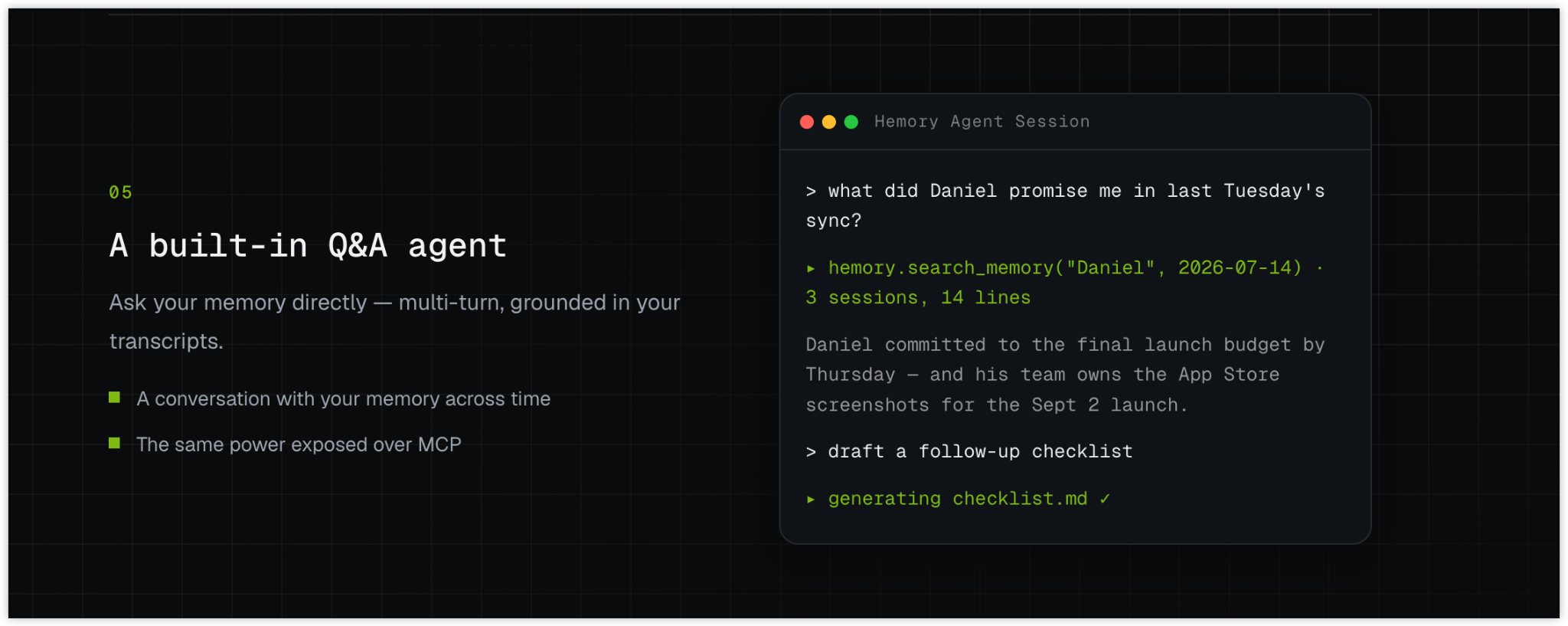
If you use an AI agent connected to Hemory through Model Context Protocol (MCP), the agent can use available conversation context to help draft that handoff. You supply the task and any current project information; you do not first have to reconstruct the entire discussion in a prompt. Your remaining work is to decide which details matter for the recipient and whether later events changed the position.
Judge the improvement by the task you finish
After using searchable records for a few instances of the same task, compare the work involved:
- Could you recover the relevant reason, condition, or commitment?
- Did you need someone else to reconstruct the discussion?
- Could you use the context in a brief, answer, or follow-up without summarizing the whole conversation yourself?
- Was any remaining difficulty caused by missing information, rather than by a search problem?
A larger archive is not an improvement by itself. The useful change is being able to complete a task with less reconstruction while keeping the context needed for a sound decision.
FAQ
How do I distinguish a search problem from a follow-through problem?
If you cannot recover what was agreed, retrieval or capture may be the issue. If you can find the agreement but the work is unassigned, delayed, or forgotten, address the action list and ownership. Keeping a commitment searchable makes it easier to review; it does not establish that the task was completed.
Do I need to record every conversation?
Start with the discussions that repeatedly support later work, such as customer interviews, project decisions, or working sessions. Use recording where appropriate and with participants’ agreement. The aim is to preserve useful context without creating an obligation to review every conversation afterward.
Will searchable records replace handoff meetings?
They can reduce time spent recovering facts that were already discussed. A handoff conversation may still be useful for explaining priorities, checking understanding, or deciding what happens next. Bring the recovered context into that exchange so it starts further ahead.
Choose one recurring task where you keep rebuilding the background. Use Hemory to preserve the discussions behind it, then return with a real question when the task comes around again. That gives you a practical way to see whether more of your attention can stay on the conversation now—and the work it supports later.