

 Hemory Team
On this page
A phone can hold years of short voice notes with no useful titles. If you remember the idea but not the filename or date, scrolling through the list may not help. Hemory’s built-in Q&A can retrieve transcript-based information across conversations that are already captured and accessible in your Memory. It cannot search a discussion it never received, and the supplied product information does not establish automatic import of an existing phone memo library.
TL;DR
- First confirm that the note is part of Memory accessible in Hemory. Don’t assume an existing phone archive has been imported.
- Ask a natural-language question using the idea or detail you remember. Refine it with another clue if needed.
- Treat a result as a lead, not proof that every relevant note has been found. Check the transcript and use another available source if the detail matters.
Check whether the note is searchable
Hemory’s Q&A answers questions about the user’s Memory and supports follow-up questions based on transcripts across different conversation sessions. That makes it useful for finding a captured thought by what was said, rather than relying on a filename or a remembered date. The Features page describes transcript-based Q&A and retrieval across sessions (Hemory Features).
The important first question is where the recording lives. If the voice note is only in an older phone memo library, don’t assume Hemory can see it: the available product information does not establish that existing voice memo files can be imported. Use a search or playback option available in that archive, or another record you can access. If the conversation was captured in Hemory and is available in your Memory, you can try asking about its content.
Ask about the idea, not the filename
Open Hemory’s built-in Q&A and describe the thought you remember in ordinary language. You do not need to reconstruct a full timeline or write out the whole conversation first. A topic, a phrase, or one distinguishing detail can help express what you are looking for.
For example, you might ask: “What did I say about making our weekly planning meeting shorter?” If the first answer points to a possible match but leaves out the detail you need, follow up: “What change did I suggest?”
Use clues you genuinely remember. A person’s name or a distinctive phrase can narrow what you mean, but don’t invent details just to make a question sound specific. Hemory’s Q&A works with its accessible Memory; a question cannot supply access to an uncaptured recording.
Review a possible match
Read the answer in context. Check whether the topic and detail fit the note you had in mind, and whether the answer reflects a recorded statement or only a related conversation. A transcript is a record of speech, not a guarantee that every word was captured perfectly.
If you need the exact wording, look at the relevant transcript passage rather than relying only on a short answer. Hemory describes timestamped transcripts and playback for transcript lines on the listening device. Use playback when it is available and the original audio would help clarify the wording.

Find individual statements in a searchable transcript.
A result is not a completeness check. If you don’t find the note, try a different phrase or clue you actually remember. A missing result does not establish that the conversation was never recorded, that no related note exists, or that the idea was never discussed. Check other available records if the information affects a decision.
Make future notes easier to retrieve
For conversations you want to find in Hemory later, listening must start through Manual Mode or a Schedule Mode session you have set up. Schedule Mode sends a reminder with a one-tap start; it does not mean Hemory silently starts listening in the background. Hemory currently lists iOS, Apple Watch, Android, and Wear OS as supported platforms. Check the current product information for the platform and listening setup you plan to use.
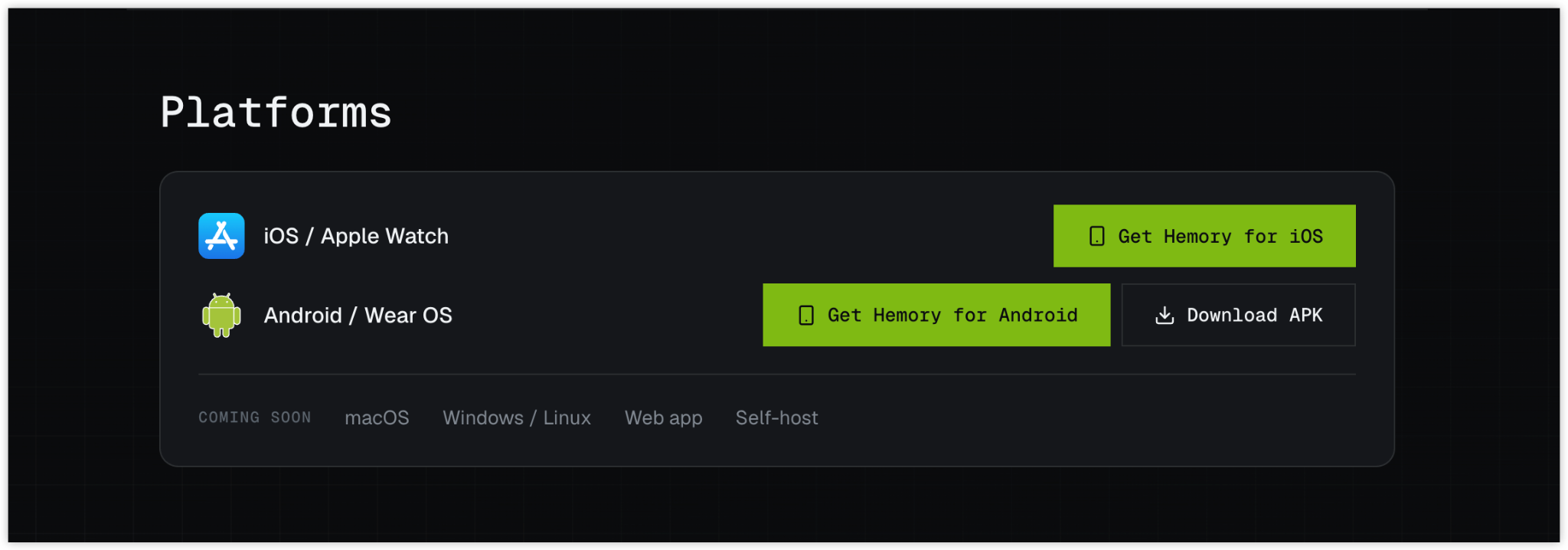
See the mobile and wearable platforms listed on the site.
When a useful thought comes up, you can focus on the conversation instead of choosing and writing down every detail that might matter later. If a future question depends on information that was not captured, use another source or ask someone who knows; Hemory cannot reconstruct an uncaptured exchange.
FAQ
Can Hemory search voice memos already stored on my phone?
Only recordings captured and accessible in Hemory are within the scope described here. The supplied product information does not establish automatic import of an existing phone memo library, so check current import options before relying on that route.
Do I need to remember the date or exact wording?
No. Start with the topic or a detail you remember and ask in natural language. A clue can help you frame the question, but it does not guarantee that a matching note will be found.
If Hemory finds nothing, does that mean I never recorded the idea?
No. The result may be missing, the wording may not match what you remember, or the note may not be accessible in Hemory. Try another genuine clue and check other available sources before drawing a conclusion.
Start with one captured conversation you expect to be able to find. Ask about its content, then review the relevant passage. That gives you a practical way to judge whether this retrieval route fits your notes without assuming it can search recordings outside Hemory.