 Hemory Team
On this page
A project message says “approved,” but you need to explain why that option was chosen. If the reasons were discussed in the thread, start with chat search. If they were spoken during a meeting, look for the saved discussion. The approval message alone may not contain the answer.
This guide compares searching work messages with retrieving captured spoken conversations. It helps you decide where to look, when to combine the two records, and when the missing explanation needs to be recorded in future discussions.
TL;DR
- Use chat search when the relevant discussion or its notes are available in your chat workspace or connected sources.
- Use conversation memory when the reasoning was spoken and has been preserved as a retrievable conversation record.
- A decision may span both: an oral discussion, a written approval, and a later change. Keep that sequence intact.
- Hemory captures and organizes real-world conversations, adding context you would otherwise have to record, summarize, and supply to an AI tool yourself.
What each approach gives you access to
Here, chat search means searching work messages, threads, and shared material, such as information available in a team chat workspace. Some tools also search connected sources. A separate use of the term is searching your history with an AI assistant; the focus here is the record of discussions with other people.
It is not necessarily limited to literal keyword matching. For example, Slack’s AI search features can answer questions using relevant workspace information and provide citations. Availability depends on factors including the plan and access settings. If the reasons for a decision are in those records, a chat-based search or answer can help recover them.
In this guide, conversation memory means a record of spoken conversations that is preserved, organized, and available for later retrieval. Hemory builds that record from real-world discussions, including meetings, working sessions, and voice notes. Transcripts preserve the content; organized Memory helps you return to topics, decisions, and other details.
For a closer look at how transcripts, summaries, and retrieval fit together, see how conversation memory works.
The two can overlap. Notes from a recorded meeting might be shared in chat, making some spoken context searchable there too. The practical question is whether the information you need made it into the accessible record.
Choose the starting point by the record you have
| Situation | Where to start | What to look for |
|---|---|---|
| The options and rationale were discussed in a chat thread | Chat search | The thread’s conclusion, conditions, and later replies |
| A meeting shaped the decision and was captured in Hemory | Conversation memory | The relevant discussion, its rationale, and the outcome |
| Chat contains the approval but omits the discussion | Search chat for the approval, then the captured conversation for context | How the reasoning led to the final choice |
| A later message changed a condition agreed verbally | Both records | Which part of the earlier agreement still applies |
| The discussion was never recorded or written down | Ask a participant or decision owner | A reconstruction, clearly distinguished from a preserved record |
The age of a decision is only a search clue. An old, well-documented thread can be easier to use than a meeting from yesterday that left no record. Start with the source most likely to contain the answer, then extend the search if it is incomplete.
Read the conclusion, not just a mention
Once you reach the right discussion, look for what was agreed and the condition or reason that affects the decision now. A message approving an option may depend on a requirement explained earlier in the exchange.
If a later record seems to conflict, check whether it changes the agreement or merely raises a new possibility. A suggestion to reconsider does not establish that the original decision was replaced. This distinction matters when a decision spans a meeting and a chat thread.
Example: a decision split between a discussion and chat
Consider a team choosing a venue for a customer workshop. During a site visit, they discuss two options:
- The studio has better equipment but requires attendees to use stairs.
- The hotel has step-free access but a smaller breakout area.
The team chooses the hotel because a participant needs step-free access. Later, a chat message confirms the booking. A week afterward, another message says the studio has offered a discount.
Searching the chat may surface the booking and the discount, but it cannot reveal the access discussion unless someone recorded or shared it there. Looking only at the price messages could make the original choice appear arbitrary.
If the site-visit discussion was captured in Hemory, you can ask:
Why did we choose the hotel for the customer workshop, and what requirements mattered in that discussion?
Then use the chat record to check the booking and any subsequent agreement. The discount message is new information, but it does not by itself establish that the venue decision changed.
A concise decision note would be:
| Item | Working record |
|---|---|
| Choice | Hotel venue |
| Reason | Step-free access was required for a participant |
| Written confirmation | Booking approval in the workshop thread |
| Later information | Studio offered a lower price |
| Current question | Does the studio now meet the access requirement, and has anyone approved a switch? |
This note makes the next discussion more useful. Instead of repeating the whole venue comparison, the team can focus on the requirement that would justify changing the choice.
What capturing the discussion adds
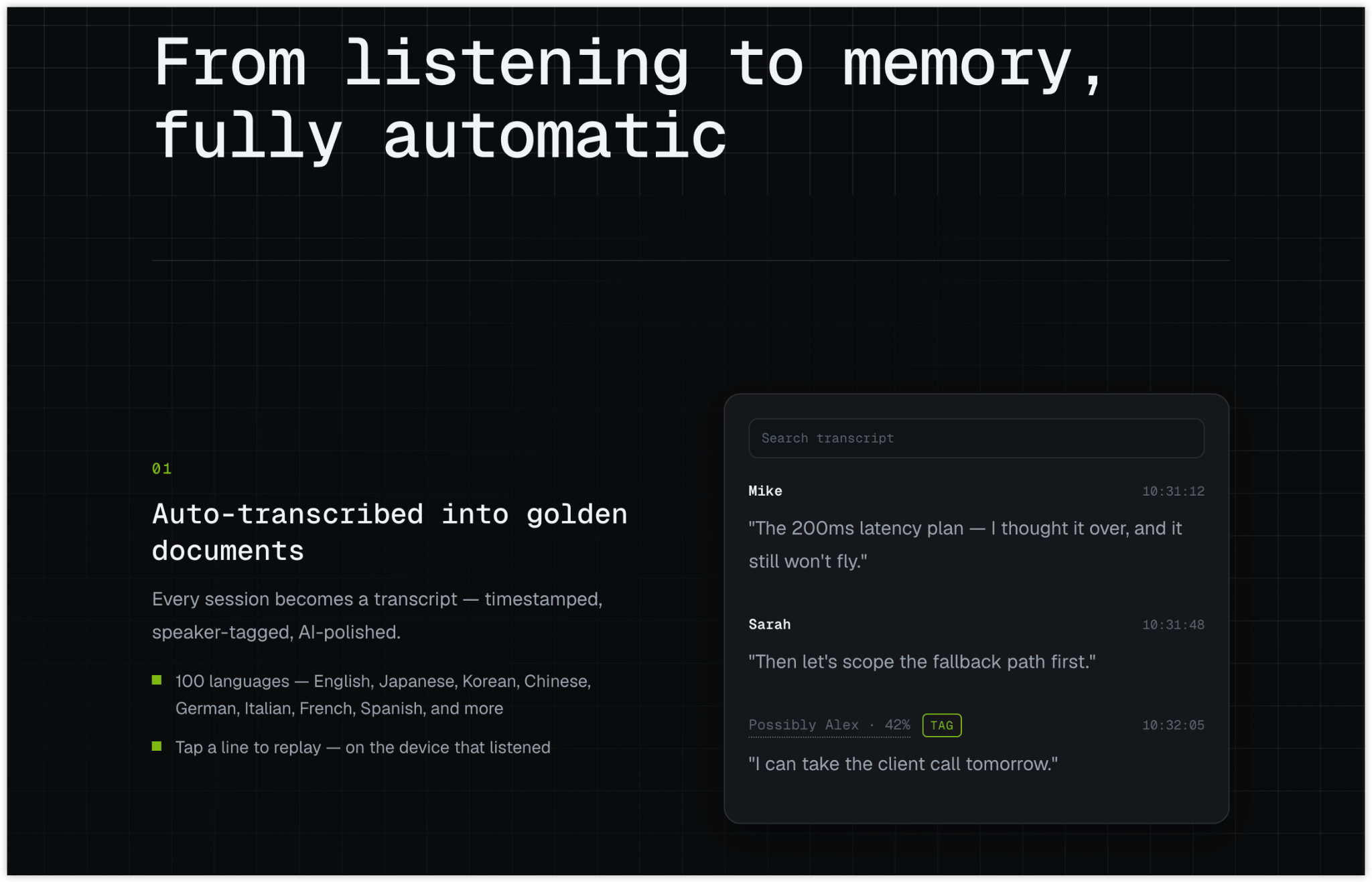
Without a record of the site visit, someone must remember the access concern and explain it again. Hemory captures the discussion as it happens and organizes it afterward, so you can focus on assessing the venues rather than anticipating every detail you may later need to document.
When the venue choice is questioned, you can return to the access requirement even if nobody added it to the booking message. The benefit is preserving the reason alongside the final choice. A supported AI agent connected to Hemory can use that saved explanation in later work, with any written approvals supplied separately if they are outside its access.
Decide what your current setup is missing
Choose one recent decision that was difficult to explain. Ask where the difficulty came from:
The explanation was already written down, but you did not find it. Improve how you search or reference the existing record. Adding another capture tool may not address that problem.
The explanation was spoken and not preserved. Begin capturing similar discussions where appropriate. Hemory can help create a retrievable record for the next occasion; it cannot fill in an unrecorded past conversation after the fact.
The explanation exists, but parts are spread across records. Bring together the specific sources that matter. A short decision note can connect them without duplicating the entire history.
The team never reached a decision. Settle the open question. More searching will not substitute for agreement.
FAQ
Can chat search explain why a decision was made?
Yes, when the reasoning is present in information the search can access. That may be a thread, meeting notes, a shared file, or a connected source. The limit is missing or inaccessible context, not a universal inability to interpret a question about “why.”
Do I need both chat search and conversation memory?
Use the records your work requires. If decisions and their reasons are documented well in chat, that may be enough. If important details regularly arise in spoken discussions, preserving those conversations can fill a recurring gap.
Does a transcript prove that a suggestion became a decision?
Only if the surrounding discussion establishes agreement. Read or retrieve the conclusion, including conditions and later changes. A transcript preserves the exchange; deciding what it means still requires attention to context.
What if the original conversation was not captured?
Ask a participant to reconstruct the relevant point and confirm it with the decision owner when needed. Keep that explanation distinct from a contemporaneous record. For future discussions, choose a capture habit that fits where your decisions actually take shape.
If spoken reasoning is the part you keep losing, explore Hemory for the discussions behind your next decision. Keeping that context available gives you more to work with than the final approval message alone.