

 Hemory Team
On this page
Typing is awkward when you’re walking or running, and interacting with a device while driving can be dangerous. If you talk through a problem as you move, a useful idea or the reasoning behind it may be hard to recall once you’re back at a desk.
A simple approach is to start listening before you set off, speak naturally, and return to the captured session afterward. Hemory can organize the conversation and help you retrieve it later, so you don’t have to decide in the moment which details are worth writing down.
TL;DR
- Start listening intentionally before you move. Manual Mode starts when you begin listening; Schedule Mode sends a reminder and offers a one-tap start.
- Talk through the problem, options, and unanswered questions. You do not need to turn your thoughts into polished notes while moving.
- Later, ask Hemory’s built-in Q&A about the captured session. Check the transcript if the exact wording matters; transcription can contain errors.
- If you’re driving, set up and start listening while parked. Do not handle or interact with a device while driving.
Start listening before you begin
Hemory captures when you start listening in Manual Mode or respond to a Schedule Mode reminder. Schedule Mode is not an instruction to assume recording has already started: the reminder offers a one-tap start or stop action.
For a walk or run, start listening before you set off, or begin from a reminder when you can do so safely. Apple Watch can capture and upload listening content independently, but you still need to start listening. Its listening time and battery use vary by model, so do not assume one model’s figures apply to all watches.
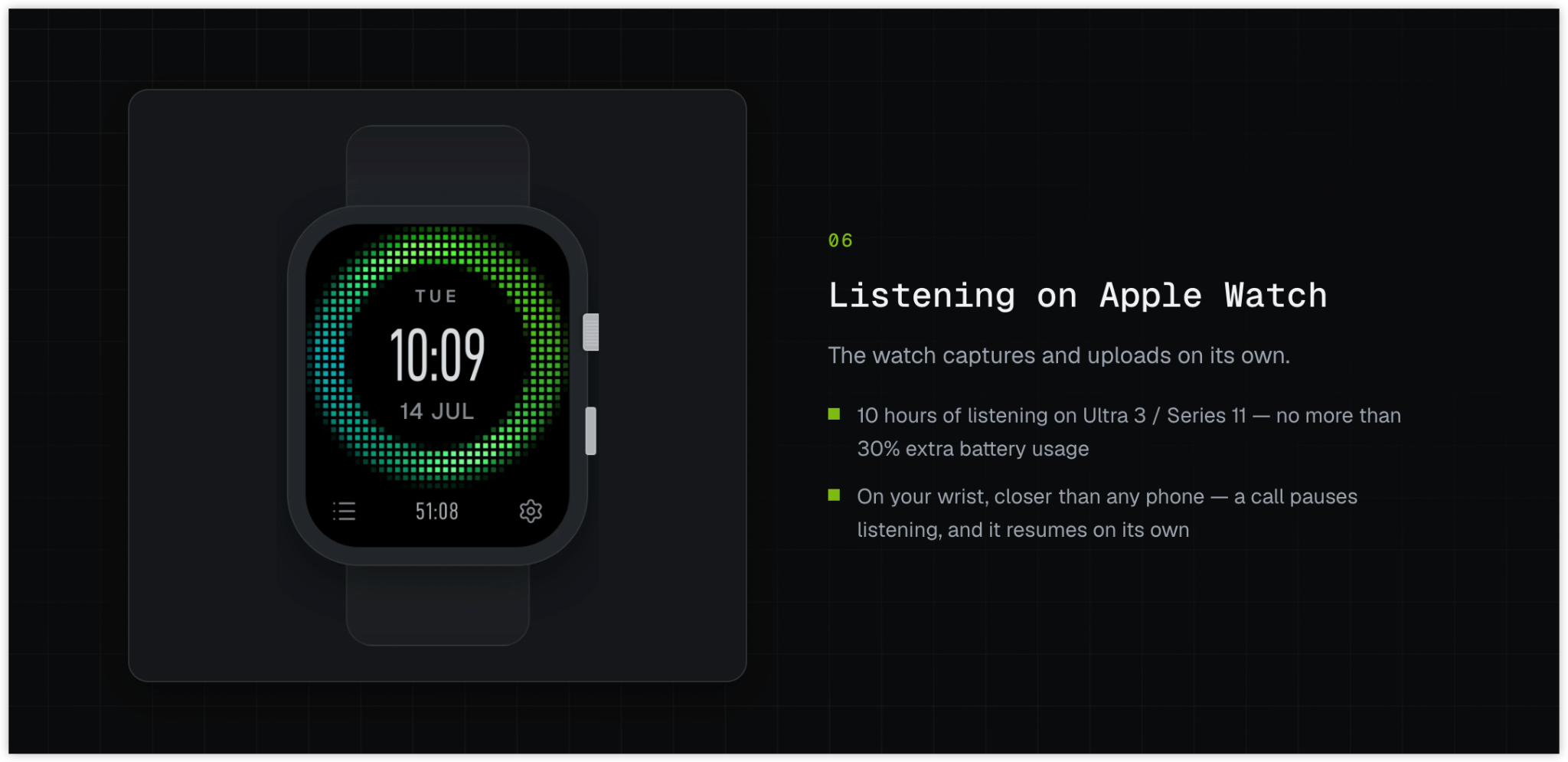
Hemory listening interface shown on Apple Watch.
For a drive, choose the setup while parked and start listening before moving. Do not reach for a phone or watch, tap a reminder, or otherwise operate a device while driving. The available product information does not establish a driving-specific hands-free start method. If you cannot start safely beforehand, wait until you can stop safely.
Talk through the problem, not a polished note
Once listening has started, speak as you normally think. You can make the recording more useful by saying what you’re trying to solve, what possibilities you’re considering, and what still feels uncertain. You might also state a next question to return to later.
For example: “I’m trying to work out why the launch plan feels too crowded. We could move the partner announcement, or reduce the number of launch-day changes. I’m not sure whether the support team can cover both. I need to check the rollout dates before choosing.”
That kind of explanation gives you more to work with later than a single phrase such as “launch plan.” You do not need to record every thought or speak in a particular format. The point is to keep the reasoning you may want to revisit, without stopping to select and type it while you move.
Retrieve the thought when you’re ready to review
After you’re back at a desk, ask Hemory’s built-in Q&A about the session you captured. For example: “What options did I consider for the launch plan, and what was I unsure about?” Hemory’s Q&A can answer questions about your Memory across conversation sessions using transcript-based context.
Use the response to return to the reasoning, not as a guarantee that every detail was captured or retrieved. If the answer misses something, try a more specific question or review the relevant transcript. Transcripts may contain errors; when exact wording matters, inspect the transcript line and use playback on the listening device if it is available.

Find individual statements in a searchable transcript.
If listening never started, Hemory cannot recover that uncaptured conversation. Use any notes or other records you have, or record what you still remember when it is safe to do so. A later recap is your recollection, not a verbatim record of what you said earlier.
Make the captured thought useful
Before acting on an idea, identify what you concluded, what remains uncertain, and what information you need next. In the example, the speaker has not chosen an option; checking the rollout dates is the next step. Keeping that distinction clear prevents a thought you explored aloud from becoming a decision you never made.
Try the approach on a walk or another movement routine where you can start listening safely. You can then return to your captured reasoning without having to reconstruct it from memory or write it all down as you go.
FAQ
Does Hemory start recording automatically when I begin walking or driving?
No. Manual Mode starts when you begin listening. Schedule Mode sends a reminder and offers a one-tap action. Start listening before moving or respond only when it is safe to do so.
Can I retrieve an idea if I forgot to start listening?
Not from that uncaptured conversation. Use another record if one exists, or make a later recap while stopped; treat it as your recollection rather than the original recording.
Should I trust the retrieved answer as an exact transcript?
No. Hemory’s Q&A uses transcript-based context, and transcripts can contain errors. Review the transcript when exact wording matters.