

 Hemory Team
On this page
A useful idea can arrive while you’re walking, commuting, or moving between meetings—exactly when stopping to type is awkward. A voice capture can preserve the thought with less interruption, as long as you control when listening starts and stops. Here’s how to capture it on a supported device and find the recorded conversation later.
TL;DR
- In Manual Mode, start and stop listening yourself. Schedule Mode lets you set listening times and receive reminders with one-tap start and stop actions; it does not mean silent, automatic recording.
- Say the idea in a way that will help you recognize it later: include the topic and what you were thinking or wanted to do.
- After the session is captured, use Hemory’s built-in Q&A to ask about the idea across your conversations. It can help retrieve relevant material, but it cannot recover an exchange that was never recorded.
Choose how to start listening
Hemory supports listening on iOS, Apple Watch, Android, and Wear OS. Choose the mode that fits the moment and the device you’re using.
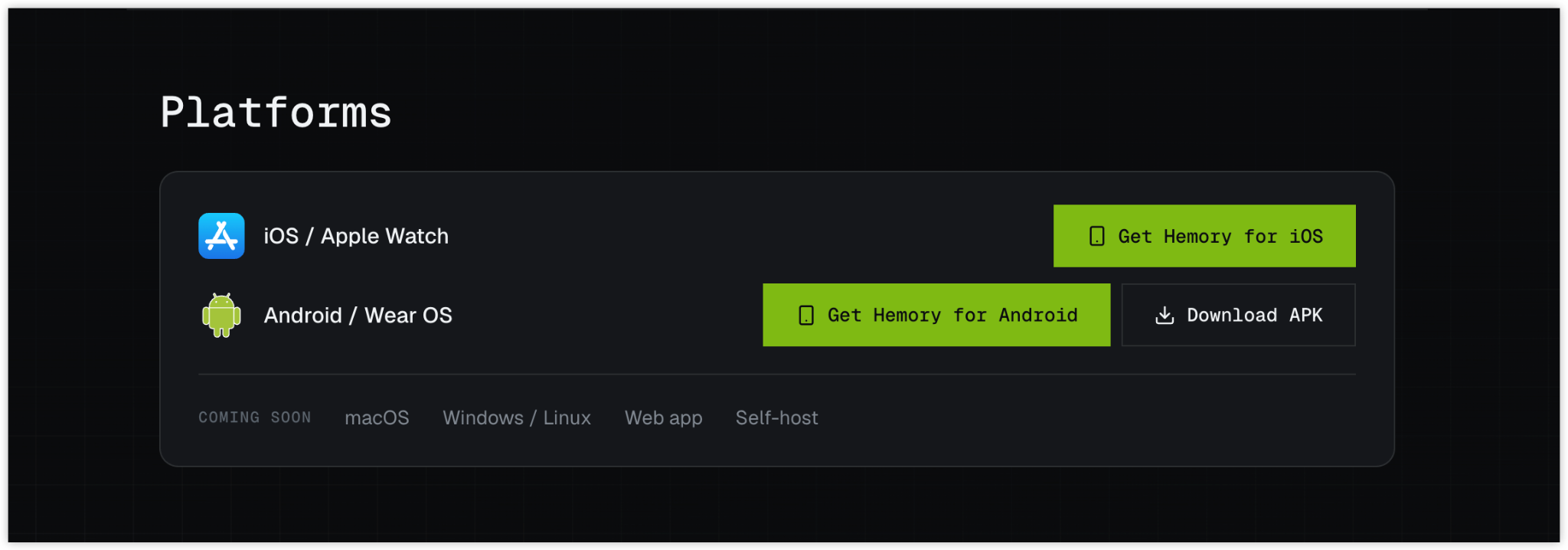
See the mobile and wearable platforms listed on the site.
| Mode | How it works | Useful when |
|---|---|---|
| Manual Mode | You start and stop listening yourself. | An idea arrives unexpectedly and you want to capture it now. |
| Schedule Mode | You set listening times and receive reminders with one-tap start and stop actions. | You often have ideas during a predictable part of your day and want a reminder to start listening. |
Neither mode should be treated as permission for Hemory to begin recording without your action. Start listening only when it’s safe and appropriate to do so, and follow any relevant privacy or consent rules.
Capture the thought without turning it into a speech
Once you start listening, say the idea in your own words. You don’t need to dictate a polished note or decide whether it deserves a formal record. A little identifying context can make the thought easier to find later.
For example, you might say: “For the onboarding flow, could we let people save a draft before inviting their team? That might help someone who needs to gather the details first.” The topic, suggestion, and reason give you more to recognize than a fragment such as “save draft.”
When you’ve finished, stop listening. Hemory creates a timestamped transcript and organizes captured activity. Transcription can contain errors or omissions, so treat the record as useful material to review rather than a perfect copy of every word.

Find individual statements in a searchable transcript.
Find the idea when you need it
This step applies to conversations that were captured and are accessible in Hemory. If the thought was never recorded, Hemory can’t reconstruct it; use another note or source, or ask someone for a focused clarification if needed.
For a captured idea, ask Hemory’s built-in Q&A Agent a direct question, such as: “What idea did I mention about saving a draft in the onboarding flow?” If you don’t remember the exact phrase, describe the topic or situation you do remember. The Q&A Agent supports multi-turn transcript-based questions and retrieval across conversation sessions, so you can refine your question if the first answer needs more context.

Retrieve past commitments and draft follow-up tasks.
Use the response to locate and review the relevant material. A result can help you recall what you said, but it doesn’t establish that the idea was approved, assigned, or acted on. If the wording or nuance matters, check the available transcript context before using it in a decision or handoff.
Make the next capture easier
The practical goal is to stay with the moment rather than pause to select and type every thought that might matter. Start listening manually when an idea comes unexpectedly, or set a schedule and use its reminder when that better fits your routine. Later, ask about the captured thought instead of relying on memory alone.
Does Hemory record automatically in Schedule Mode?
No. Schedule Mode uses set times and reminders with one-tap start and stop actions. You remain in control of starting and stopping listening.
Can Hemory find an idea I didn’t capture?
No. Retrieval works with captured, accessible conversations. If the idea wasn’t recorded, check another source or make a new note from what you remember.