

 Hemory Team
On this page
An AI agent can work with the information available to it, but that may not include what your team discussed last week. If a decision, constraint, or explanation lives only in a past conversation, you may have to remember it and retell it before the agent can use it. Retrieving relevant, previously captured conversations can supply that missing background—when the records are accessible to the tool.
Bring past conversations into AI workflows with searchable memory.
TL;DR
- An AI agent does not automatically know every past conversation. It can use only the information available through its current chat, connected sources, or material you provide.
- Earlier discussions can contain reasoning, conditions, and unresolved questions that a short recap leaves out. Retrieving relevant records can reduce the work of reconstructing that background.
- Retrieval depends on conversations having been captured and being accessible through the tool. It cannot guarantee that every relevant detail will be found.
- Hemory organizes captured conversations and provides built-in Q&A and supported connected-agent access. You still set the current goal, add new information, and review the result.
Why the current AI conversation may not have enough context
An AI agent responds using the information available in its current task. That may include the current chat and any sources the agent can access, but it does not automatically include every discussion you have had elsewhere. A different chat, a meeting, or a spoken decision may not be present unless it was captured and made available through a relevant tool or connection.
This creates a gap between what a person remembers—or assumes the agent knows—and what the agent can actually use. The user may need to repeat the background, search for a record, or leave out a detail they did not think to mention. That can make a draft incomplete or lead to follow-up questions that the earlier discussion had already answered.
What past conversations can add
A conversation can preserve more than its final decision. It may contain the reasons behind a choice, the conditions attached to it, a concern that was not resolved, or a change in priorities. Those details can affect how a current request should be interpreted.
For example, suppose a team asks an agent to draft a customer update. An earlier discussion may explain that a feature is still under review and that the team has not committed to a release date. Without that background, the agent could produce wording that sounds more certain than the team intended. With accessible conversation context, the agent has a better basis for drafting cautiously—though the user still needs to review the wording and confirm any current facts.
Past context is useful when it changes the answer, scope, tone, or next action. It is not a reason to supply an entire conversation archive for every task.
How Hemory can provide that context
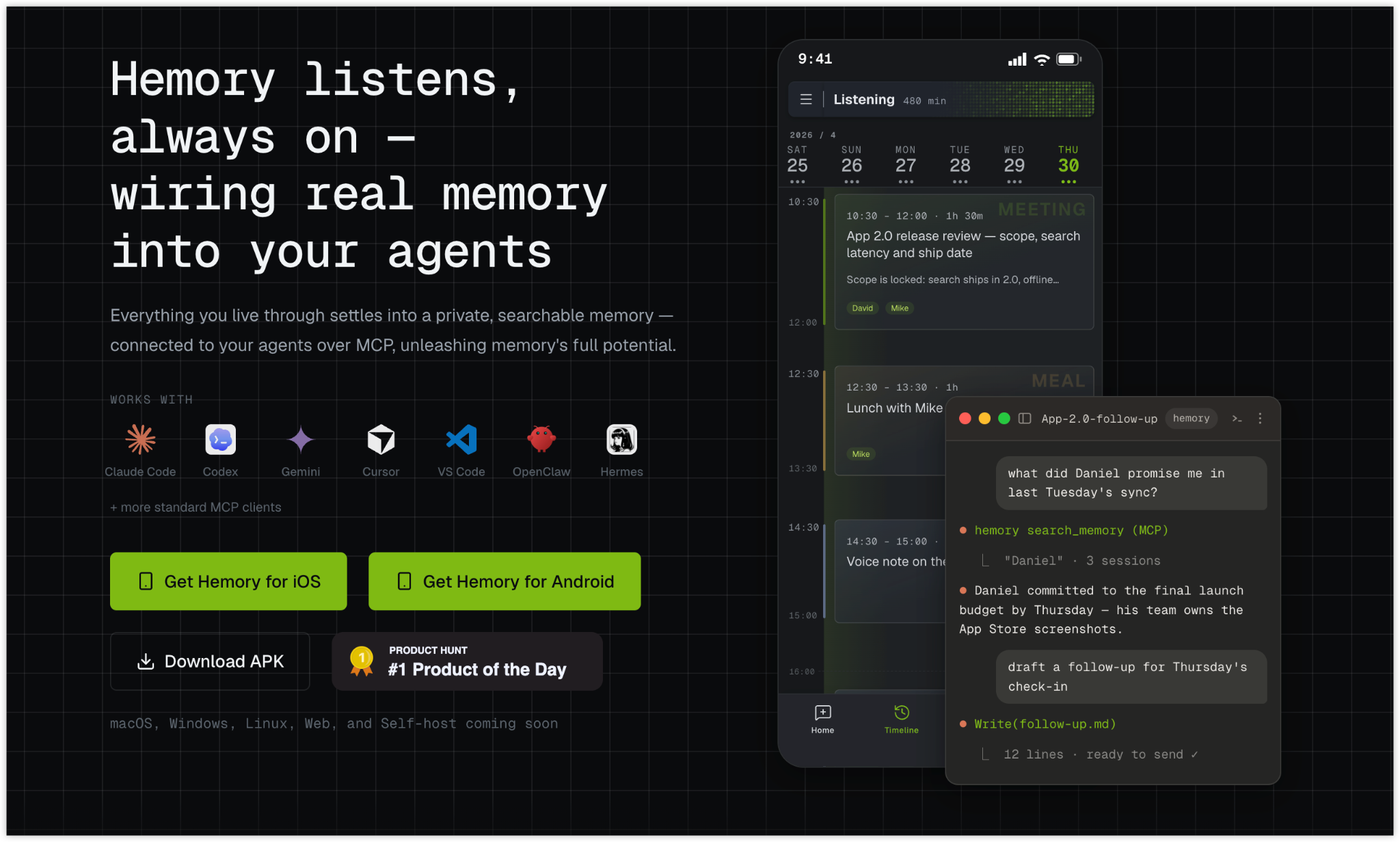
When a discussion has been captured in Hemory, it can become part of organized, searchable Memory rather than something the user has to reconstruct from memory alone. Hemory’s built-in Q&A supports questions about the user’s Memory, including transcript-based follow-up questions across different conversation sessions. A supported connected AI agent can also retrieve accessible Hemory context for its task; the agent then performs its own reasoning and drafting.

Retrieve past commitments and draft follow-up tasks.
That distinction matters: Hemory captures, organizes, and provides access to conversation context. The agent uses whatever context its supported connection makes available. The user supplies the present goal and any new information, then decides whether the output is accurate and appropriate.
The practical benefit starts during the conversation. Instead of trying to write down every potentially useful detail while participating, you can preserve the discussion for later retrieval. When a task comes up, the agent may be able to find relevant background without requiring you to prepare a full chronology or retell the whole story.
What context retrieval can—and cannot—cover
Retrieval works only when the relevant conversation was captured and the chosen tool can access it. An uncaptured exchange cannot be reconstructed from Hemory. If an important detail is missing or inaccessible, use another available record or ask someone a focused question.
Access also varies by route. Hemory’s built-in Q&A and an external agent connected through a supported integration are different ways of working with Memory; do not assume every AI agent has the same access, scope, or permissions. Connection details depend on the specific client and are separate from the general idea of conversation context.
Even when records are available, retrieval is not a guarantee that every relevant detail or omission will be found. A transcript is a record of speech, not proof that every statement was correct or that a decision was approved. Check consequential wording, conditions, current status, and authority before relying on the result. If the discussion left a point unresolved, keep it unresolved rather than treating a plausible answer as an agreement.
A useful way to think about it
Treat past conversation context as one possible source for a current task—not as a substitute for the task itself. The agent still needs to know what you want now. Earlier discussions may help explain the background, but current instructions, updated facts, and human judgment determine what to do with it.
If you repeatedly have to rebuild the same background for AI work, start with a practical question: where was that information discussed, and was it captured somewhere the tool can access? Hemory can help preserve and retrieve captured conversations, reducing some of the searching and retelling. The output still needs your review, especially when a decision, commitment, or current status matters.
FAQ
Does an AI agent remember every conversation I have had?
No. An agent can use only the information available through its current chat, connected sources, or material you provide. Access to other conversations depends on whether they were captured and whether the agent’s supported connection can retrieve them.
Can past conversation context replace a prompt?
No. The current task still needs a clear goal and any new or changed information. Past context can reduce the need to retell background, but it does not tell the agent what you want done now.
Will retrieval find every relevant detail?
Not necessarily. Results depend on what was captured and what the tool can access and retrieve. Review important findings and follow up when a missing detail could change the decision or output.
Is conversation history the same as an AI agent’s chat history?
No. An agent’s chat history is the conversation within that AI tool. Captured real-world conversations are a separate source, which a tool can use only when they are available through a supported route.
If an AI task keeps sending you back to search for the same background, preserving relevant conversations can make that context easier to reuse. Set the current goal, retrieve what is available, and review the parts that affect the result.