

 Hemory Team
On this page
You may use a coding agent, a general chat assistant, and a writing tool for different parts of your work. If each needs the same background from real conversations, you can end up retelling it several times. The phrase “shared memory” can sound like those agents share everything. Usually, the useful idea is narrower: supported clients can draw on a common source of captured conversation context, while their own chats and working state remain separate.
TL;DR
- Shared memory across AI agents means giving supported clients access to the same relevant source of real-world conversation context.
- In Hemory, that source is Memory built from conversations already captured and accessible there. Hemory provides context access; each external agent does its own reasoning and work.
- A common source does not merge agents’ private chats, internal memory, tools, permissions, or execution state. Access and setup depend on the client.
What is shared memory across AI agents?
It is a source of information that more than one supported AI client can retrieve from, so you can use relevant background across different tasks without recreating it for each client.
For example, Hemory captures and organizes real-world conversations as Memory. Its public product information describes access to that Memory through a standard MCP server for supported external agent tools. An agent with an appropriate connection can retrieve relevant details from conversations that have already been captured and are accessible to it.
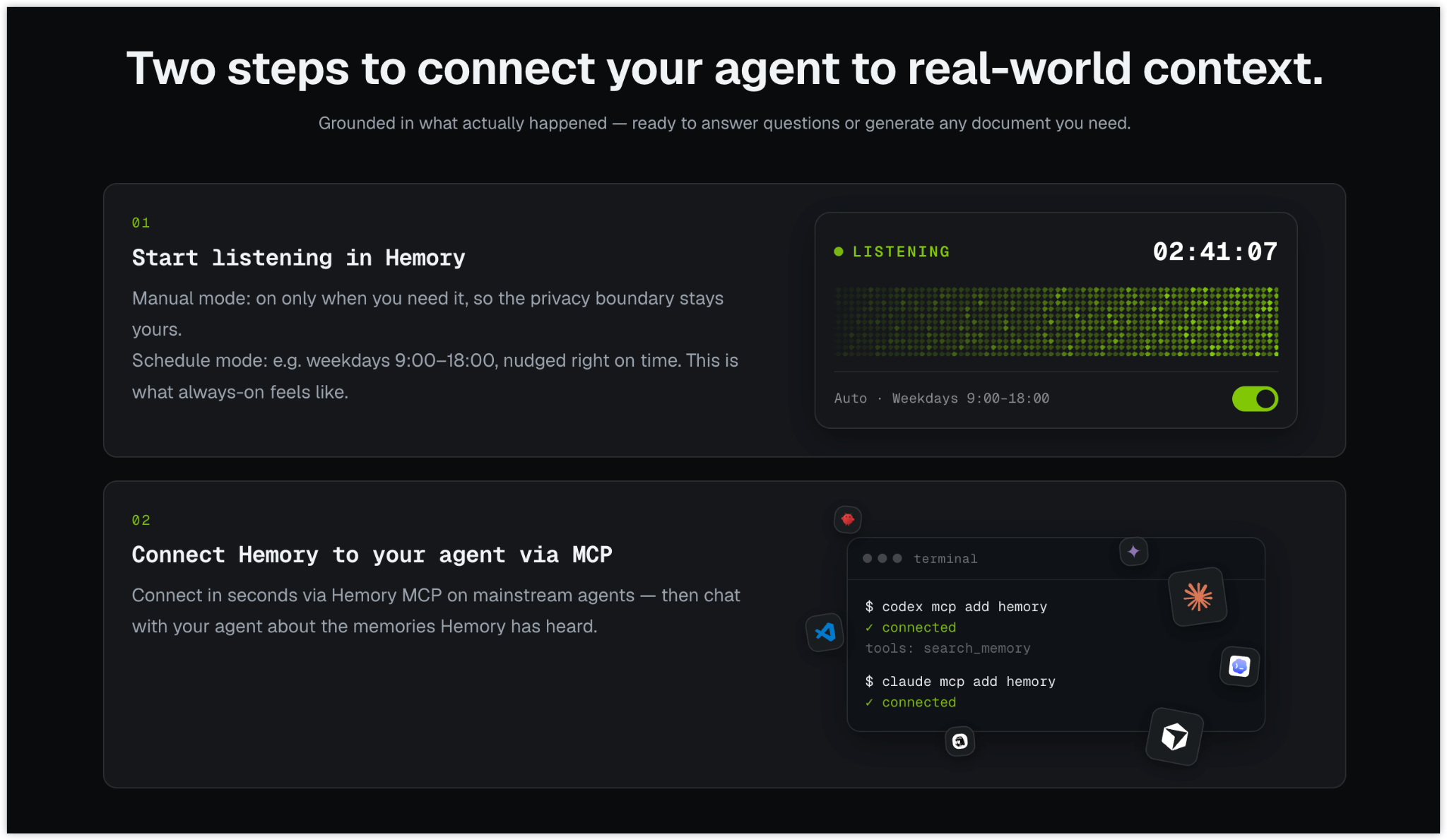
Connect an AI agent to Hemory through MCP.
Think of it as a shared reference shelf, not a shared mind. Each agent consults its own accessible copy of the source when doing a task. The agents do not automatically see one another’s chats or pass work to one another.
What does a shared source make available—and what stays separate?
| Shared conversation source | Separate for each agent or client |
|---|---|
| Relevant context from conversations already captured in Hemory and accessible through that client | Private chat history with the agent |
| Background that may help with a new task | The agent’s internal memory or working state |
| Information the user can retrieve from a common source across supported clients | The agent’s tools, reasoning, and actions |
| A basis for continuity across tasks, subject to the client’s access | Connection setup, permissions, and available data scope |
This distinction matters when you move between tools. An agent that can retrieve a past discussion may use that context in its own answer. It does not thereby gain access to another agent’s conversation with you, inherit the other agent’s work, or automatically receive a document that agent produced.
How can the same conversation context support different agents?
Suppose product discussions have already been captured in Hemory. A connected general assistant might retrieve relevant background while helping you draft a requirements outline. Later, a connected coding agent might retrieve relevant context for an implementation question. Both can draw from the same source if their connections allow access to the relevant Memory.
That does not mean the coding agent sees the assistant’s draft or knows what happened in its chat. If the draft contains decisions or current details the coding agent needs, provide that material through your normal workflow. And if an important point was never captured in Hemory, use another source or ask someone to clarify it; a shared memory source cannot retrieve a conversation it does not contain.
This is where Hemory can reduce repeated preparation: instead of manually retelling every relevant discussion to each AI client, you can let a supported, connected client retrieve context from accessible Memory. You still set the task, add new information, and judge whether the result is usable.
Why doesn’t “shared” mean every agent has the same access?
A common source is not the same as identical access. Clients can differ in how they connect, what tools are available, what information they can retrieve, and which permissions apply. A public listing of an agent client does not by itself establish that every setup, permission, or retrieval behavior has been independently verified or is identical.

Review MCP connection options and access settings.
Hemory’s role is to capture and organize conversations and make relevant Memory available through supported access routes. The external agent handles its own retrieval request, reasoning, drafting, and any actions its tools support. You remain responsible for reviewing the result and carrying information between agents when needed. Shared Memory does not create automatic handoffs, trigger an agent to start work, or grant access to external systems.
When is shared conversation memory useful?
It is useful when separate AI clients help with different tasks but need some of the same background from real-world conversations. It is less useful to expect it to synchronize private chats or replace a current brief, approved document, or other source an agent cannot access.
To assess whether a shared-memory setup fits, ask:
- Were the relevant conversations captured in the source?
- Can the client you want to use access the relevant Memory?
- What current details or outputs must you provide separately?
- What will you review before relying on the agent’s answer?
Start with one recurring task where you currently retell the same background to multiple AI clients. If the relevant discussions are already captured and accessible, a shared Hemory source can give supported clients a common place to retrieve context—while keeping each client’s own conversations and work separate.
FAQ
Do AI agents share their private chats when they use shared memory?
No. Shared access to a conversation-memory source does not give one agent access to another agent’s private chat history or internal working state.
Can every AI client access the same Hemory Memory?
Not necessarily. Access depends on whether the client is supported and connected, and on its particular tools, permissions, and data scope. Do not assume every client has the same setup or access.
Can shared memory retrieve a conversation that was never recorded?
No. It can only provide context from conversations that were captured and are accessible. For missing details, use another source or ask a focused question.