

 Hemory Team
On this page
A brief meeting note may capture a decision but leave out the reasoning, a condition, or a concern that matters to your next task. If you give an AI assistant only that note, you must decide what else to explain. A connected agent can draw on relevant conversations captured in Hemory, when those records are accessible through its connection. You still set the goal, supply what has changed, and judge the result.
TL;DR
- Notes are useful summaries; captured conversations can provide additional detail when a task depends on what was discussed.
- A connected agent can retrieve relevant context from conversations already captured in Hemory and accessible through its connection. It cannot retrieve a meeting that was never recorded.
- State what you need now, add new information the past discussion cannot contain, and review the agent’s output for accuracy and fit.
Notes and conversation memory provide different kinds of context
Meeting notes are a selected account of a discussion. They can be the best source for a concise decision, action list, or agreed plan. But a short note may omit a qualification, an alternative that was considered, or the reason a decision was made.
A conversation record can preserve more of the discussion behind that summary. Hemory describes listening sessions that produce timestamped transcripts with speaker labels and AI cleanup, along with summaries suited to the activity. A transcript is still a record of speech, not a guarantee that every word was captured perfectly or that every statement is current.

Find individual statements in a searchable transcript.
| Source | Useful for | What it may not tell the assistant |
|---|---|---|
| Brief meeting notes | Agreed outcomes, key actions, or a concise handoff | The full explanation, qualifications, or discussion behind a summary |
| Captured conversation | Finding relevant details and reasoning from a recorded discussion | What happened in a meeting that was not captured, or what has changed since |
| Current instructions and documents | Today’s goal, constraints, and latest approved information | Earlier discussion that is not included or accessible |
These sources can complement each other. Use notes when they already contain what the task requires; use conversation memory when relevant detail from the discussion may change the answer.
How a connected AI assistant can use past meetings
When relevant discussions have been captured in Hemory and are accessible through a supported connection, an AI agent can use the current task to retrieve useful background while it reasons or drafts. Hemory provides access to Memory and retrieval; the external agent performs its own analysis and generation.
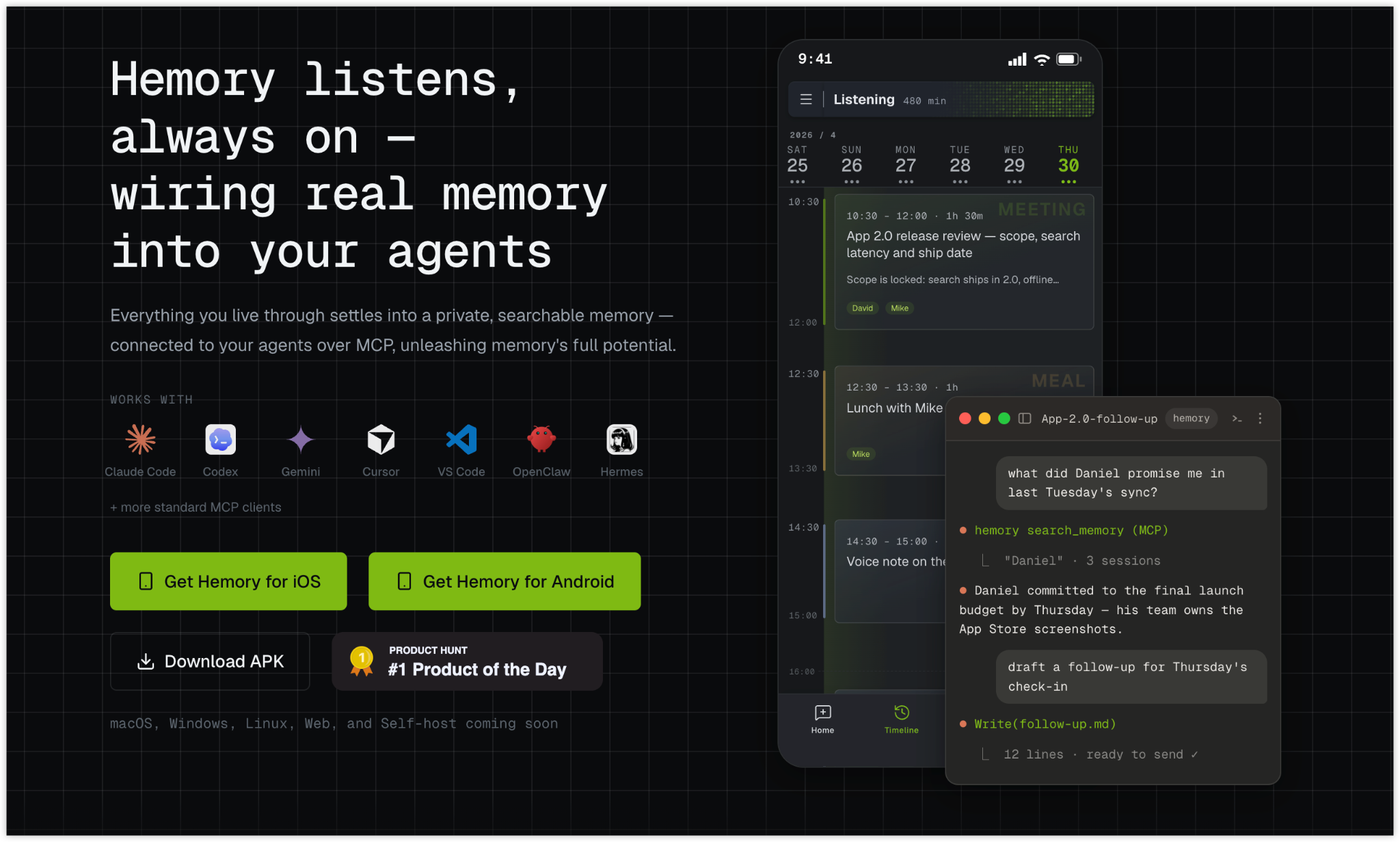
Bring past conversations into AI workflows with searchable memory.
For example, suppose your notes say, “Keep the first release focused on the onboarding flow.” You now need a product requirements draft. The earlier conversation may contain the reason for that scope or a condition that shaped it. A connected agent can look for relevant captured context rather than relying only on the short note you supplied. Treat any resulting detail as something to review, not as proof that the draft is complete.
Hemory publicly lists MCP connections for several agents and standard MCP clients. A public listing does not establish that every client has identical setup, access, tools, or behavior. The context available depends on the particular connection. Hemory does not wake an agent in the background or guarantee that it will find every relevant conversation.
What you still need to provide and review
Conversation memory can reduce the need to remember and retell every detail, but it does not know your current objective unless you state it. Give the assistant a focused request, such as: “Draft a requirements outline for the onboarding flow. Use relevant captured discussions for background. I’ll provide the latest constraints separately.”
Then add information that was not part of those past meetings: new requirements, recent changes, the intended audience, or the format you need. If the assistant cannot access a relevant conversation, use another available record or provide the missing information yourself.
Before using the output, review whether it reflects the right discussion and distinguishes what was agreed from what was suggested or left open. Check any condition, attribution, or current status that would change the next step. The assistant may organize and draft from accessible context, but you remain responsible for deciding whether its result is suitable to share or act on.
When notes are enough
If the notes already contain the facts needed for a simple task, give the assistant those notes directly. You do not need to search conversation history or use a connected agent for every request. Memory is most useful when an omitted detail or explanation could affect the interpretation or quality of the work.
Hemory also has a built-in Q&A Agent for questions about your Memory, including multi-turn transcript-based Q&A across sessions. That is a way to ask about recorded conversations; it is distinct from connecting an external assistant to Hemory to work on a broader task.

Retrieve past commitments and draft follow-up tasks.
FAQ
Can an AI assistant use a meeting that was never recorded?
No. A connected agent can only retrieve context from conversations that were captured and are accessible through its connection. For anything missing, use another source or provide the relevant information yourself.
Do I need to write a summary before asking a connected agent?
Not necessarily. State the task and any current information the past conversation cannot contain. If the relevant discussion is captured and accessible, the agent can retrieve context while working; you do not have to prepare a complete chronology first.
Should I stop taking meeting notes?
No. Notes can provide a concise record of outcomes and actions. Conversation memory can supply additional background when the reasoning or details behind a note matter. Use whichever sources fit the task, and combine them when that gives the assistant a clearer brief.
Start with the task, not a full retelling
For your next follow-up, requirements draft, or decision write-up, state the outcome you need and identify any new facts or constraints. If the relevant meeting was captured in Hemory and your connected agent can access it, let the agent retrieve useful background as it works. You can then spend your effort reviewing the draft and applying your judgment instead of manually reconstructing every discussion.