

 Hemory Team
On this page
Customer calls can contain the reasoning behind a product request: who needs something, what they are trying to do, and which constraints shape the problem. Turning several calls into a PRD by manually selecting and retelling every useful detail takes work—and it is easy to leave out something you did not realize mattered.
If the calls are already captured in Hemory and accessible to a connected, supported AI agent, you can give the agent the spec goal and ask it to retrieve relevant Memory while drafting. Here’s a workflow for getting a useful first draft without treating customer comments as approved product decisions.
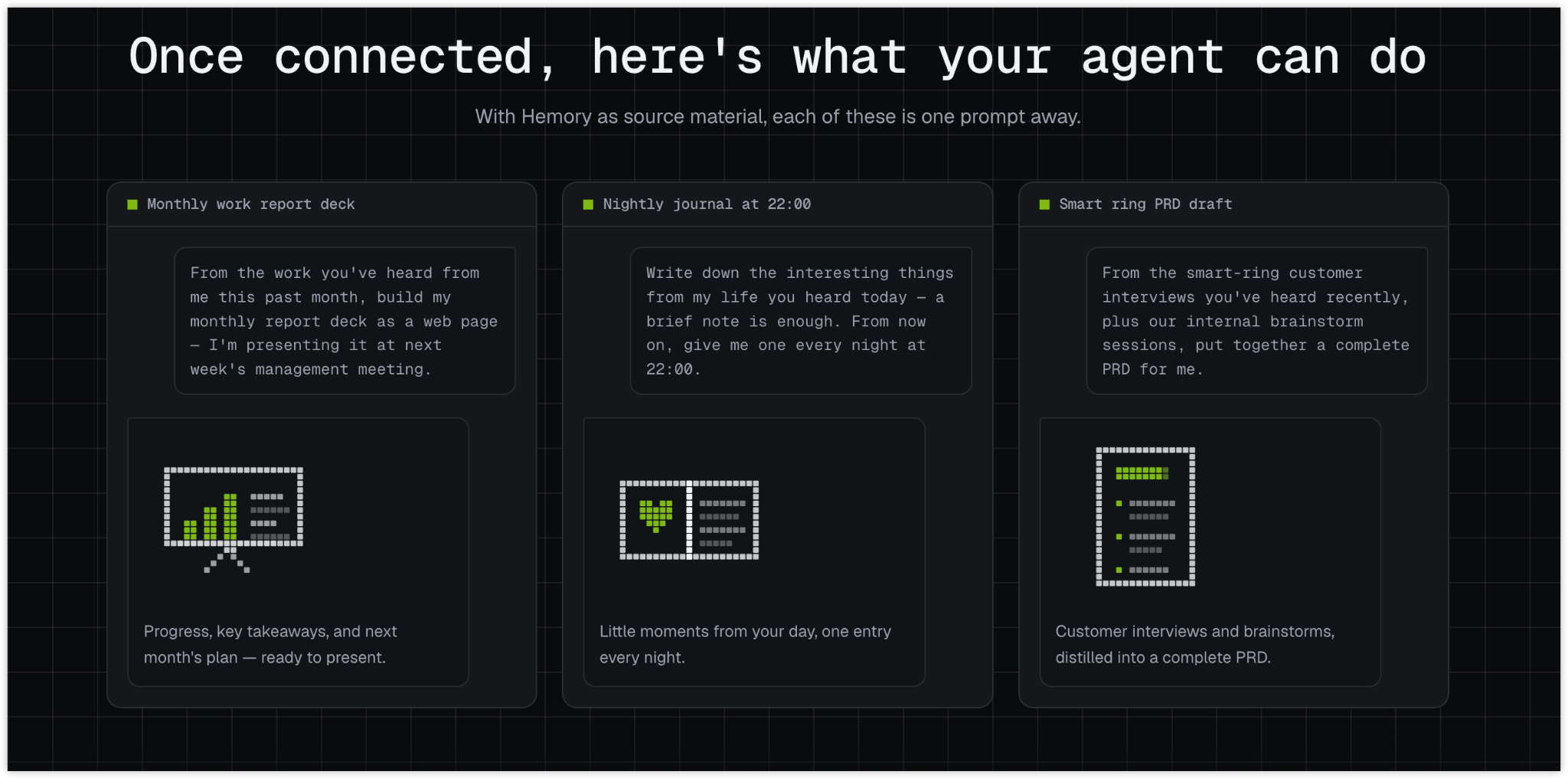
Turn saved context into reports, journals, and product requirements.
TL;DR
- State the decision or product goal the PRD should support, plus any current constraints and source boundaries.
- Ask the connected agent to retrieve relevant captured calls and draft sections with identifiable evidence; have it mark gaps, conflicts, and suggestions separately.
- Review what people said, what your team has decided, and what still needs confirmation before using the draft.
- Hemory provides access to captured Memory through supported connections; the external agent retrieves and drafts, and you provide current information and judgment.
1. Start with the spec goal and current context
Tell the agent what the PRD is for. “Write a PRD from customer calls” leaves important questions open: which product area, which users, what decision the document should support, and whether the team has already set constraints.
Give it the information that may not be in the calls, such as the intended audience for the PRD, current product limits, a target platform, or a decision the team has made since the conversations. You do not need to prepare a complete chronology or summarize every call first. Begin with the task and the current facts the agent cannot retrieve from accessible Memory.
You might include:
- Goal: What should the PRD help the team decide or build?
- Scope: Which product area or user group should it cover?
- Current constraints: What is already known about technical, policy, or timing limits?
- Requested sections: For example, problem, users, requirements, acceptance criteria, and open questions.
- Evidence standard: Ask the agent to distinguish customer evidence from its own interpretation and proposals.
Keep the goal narrow enough to guide retrieval. If you are exploring a problem rather than committing to a solution, say so; the draft should not turn an exploratory question into an approved feature.
2. Let the connected agent retrieve relevant captured calls
This workflow applies when the customer calls were previously captured in Hemory and the connected agent can access the relevant Memory. Hemory supplies retrieval; the external agent uses the material it can access to reason and draft. The exact tools and connection behavior can depend on the client, so do not assume that every agent or connection has the same access.
Ask the agent to find conversations relevant to the goal, including useful explanations, conditions, and differing views—not just calls that use the same feature name. It may retrieve useful details you did not think to mention. That can reduce the need to search for and retell every call before drafting, while leaving you responsible for supplying current context.

Retrieve past commitments and draft follow-up tasks.
If the agent cannot access a call or finds too little relevant material, use another available record or ask a focused follow-up. A missing result does not establish that nobody discussed the issue. Hemory cannot retrieve an exchange that was never captured there or is not accessible through the connection.
3. Request draft sections with traceable evidence and visible gaps
Ask for a draft, not a final decision. For claims based on customer conversations, request enough source detail for a reviewer to find and assess the supporting material. Where the connected agent can provide them, that might include the conversation or speaker and a transcript passage, timestamp, or other retrievable reference. Do not assume a particular citation format is available. If the agent cannot provide a traceable reference, have it label the claim as needing verification instead of presenting it as sourced.
A prompt can be as simple as:
Draft a PRD for [product area or decision] to help [intended team or audience] decide [goal]. Use relevant customer-call Memory that you can access in Hemory. The calls were captured before this request.

Current information and constraints:
- [Add facts or decisions that may not appear in the calls.]

Draft these sections: problem, affected users, evidence, requirements, acceptance criteria, constraints, and open questions.

For each customer-evidence claim, identify the source conversation and provide a passage, timestamp, or other retrievable reference where available. Do not invent quotations or references. Separate what customers said from your interpretation. Label requirements or priorities that are suggestions as proposed, not approved. Flag conflicting evidence, missing support, and information you cannot retrieve. Do not fill gaps by guessing.

Return a draft for review, not an approved specification.
Adjust the sections to the decision at hand. For example, a team deciding whether a problem merits investigation may need evidence and open questions more than detailed acceptance criteria. Do not ask the agent to fill every section with certainty when the source material does not support it.
4. Review the draft before it becomes a working PRD
Treat the result as a starting document. Check the points that could change what the team builds or decides:
| Review | What to look for |
|---|---|
| Attribution | Does the referenced conversation support the claim? Is a participant’s suggestion clearly attributed rather than treated as team agreement? |
| Meaning | Does the draft preserve the original condition, limitation, or uncertainty? Has a customer’s requested solution been separated from the underlying problem? |
| Coverage | Are there conflicting views, missing references, or relevant calls the agent could not access? Are gaps labeled rather than silently filled? |
| Decision status | Are approved decisions distinguished from proposals and suggested priorities? Has any current team decision you supplied been incorporated accurately? |
| Requirements | Can the requirement be evaluated? Are its acceptance criteria supported by known behavior or clearly marked as proposed? |
A customer saying a feature would help is evidence of that person’s need; it does not by itself establish broad demand, team approval, or an agreed delivery commitment. Likewise, a proposed acceptance criterion is not an existing product decision. Preserve those distinctions in the document.
For a consequential claim, follow the available reference back to the relevant record and check its wording and context. You do not need to replay or recheck every conversation; focus review on claims that affect scope, priority, or commitments. If the agent’s reference is too vague to locate the source, ask for a better reference or verify the claim from another accessible record before relying on it.
5. Revise the draft with your findings
Give the agent only the corrections or new facts needed for the next revision. For instance, clarify that a limitation is current, correct a misattributed request, or tell it that a proposed requirement should remain an open question. Ask it to revise the affected sections and retain unresolved items in the open-questions list.
The agent can help organize retrieved evidence and revise prose, but you and your team decide which requirements to adopt and whether the PRD is ready for use. Carry the reviewed draft into your normal product process; a generated document is not automatically approved or written into an external project system.
If the calls are not available to the agent
This process depends on recorded calls being captured in Hemory and accessible through the connected tools. If they are not, use another source you can access, such as existing notes or a transcript, and provide the necessary material to an assistant through an appropriate route. For future calls, preserving the discussion means you can focus on the conversation instead of trying to select and write down every detail that might later matter.
FAQ
Can an AI agent find details I did not include in my prompt?
It can retrieve relevant details from captured Memory that is accessible through its connection, so you do not have to name every useful point in advance. Retrieval may still miss relevant material; check important claims and use another source when needed.
Does every customer request belong in the PRD as a requirement?
No. A request is evidence of what a participant wanted, not automatically an approved requirement. Preserve its source and distinguish it from your interpretation, a proposed requirement, and a team decision.
Do I need to summarize every call before asking for a draft?
No, not when the connected agent can retrieve the relevant captured Memory. Give it the spec goal and current information it may not have, then review its draft and the references it provides.
Will the agent create or approve the PRD in my project system?
Do not assume so. This workflow describes retrieving context and drafting with an external agent; it does not establish permission to write to other systems or approve the result. Review the draft and move it through your team’s usual process.
Start with one real spec task
Choose a product question the team needs to resolve, state what is currently known, and ask a connected agent to retrieve relevant captured calls before drafting. Hemory can reduce the manual work of gathering and retelling those discussions; your review turns the draft into a document the team can responsibly use.