

 Hemory Team
On this page
When you draft requirements from a meeting, the discussion may contain decisions, conditions, or open questions that never appeared in an AI chat. An AI can use that material only if it has access to a record of the conversation. Here’s how captured meeting context differs from chat history, what an AI can do with it, and what still needs your review.
TL;DR
- Chat history is only one possible source of AI context. A captured meeting can provide additional information if it is accessible through the AI’s tools or connected sources.
- Hemory organizes captured conversations as searchable Memory. Its built-in Q&A can retrieve across conversation sessions, and supported connected agents can use accessible Memory.
- Access depends on the route and agent. A transcript or retrieval result is not a guarantee that every relevant detail was captured or found.
- For a requirements draft, tell the agent what you need, add current information it cannot retrieve, and review whether each statement is a proposal, an accepted decision, or an unresolved question.
What meeting context can add beyond chat history
An AI assistant may use information available in its chat, attached files, connected tools, or other sources. A meeting is a separate source: its discussion does not become part of a chat just because it could help answer a later question.
If the conversation was captured, it may contain context such as:
- what people discussed and the order in which points came up;
- stated decisions, proposals, conditions, and action items;
- explanations or rationale that were not copied into a short summary;
- questions left open for later discussion.
The record can help distinguish what was said from what the current task requires. But a mention is not automatically an agreement, and a speaker is not automatically the owner of an action. The surrounding wording and any later updates matter.
How an AI gets access to a past meeting
A conversation must first have been captured and made accessible through a route the AI can use. If it was never recorded, Hemory cannot reconstruct it; look for another source or ask someone a focused question.
With Hemory, a listening session produces a timestamped transcript with speaker labels and AI cleanup. Meeting records may also include structured notes such as topics, decisions, and action items. Hemory’s built-in Q&A supports multi-turn questions about Memory and retrieval across conversation sessions. A supported connected agent can also retrieve accessible Memory and use it in its own reasoning or drafting.

Find individual statements in a searchable transcript.
These routes are not interchangeable. A connected agent’s access and permissions depend on that client and connection. Do not assume that every agent can search the same conversations or retrieve the same details. Hemory provides captured, organized context; the connected agent performs its own retrieval and generation, and you review the result.
How that context can inform a requirements draft
Suppose a captured discussion includes a proposal to restrict account exports to administrators, but the conversation does not establish whether the proposal was approved or whether exports belong in the first release. That distinction is useful context for a requirements document: the draft should preserve the proposal without presenting it as a settled requirement.
You can give a connected agent the task—such as drafting requirements from earlier product discussions—and add current constraints or documents it cannot access. The agent can retrieve relevant Memory and prepare a draft without requiring you to reconstruct every meeting in a manual timeline first. Then review consequential statements against their context and current status.
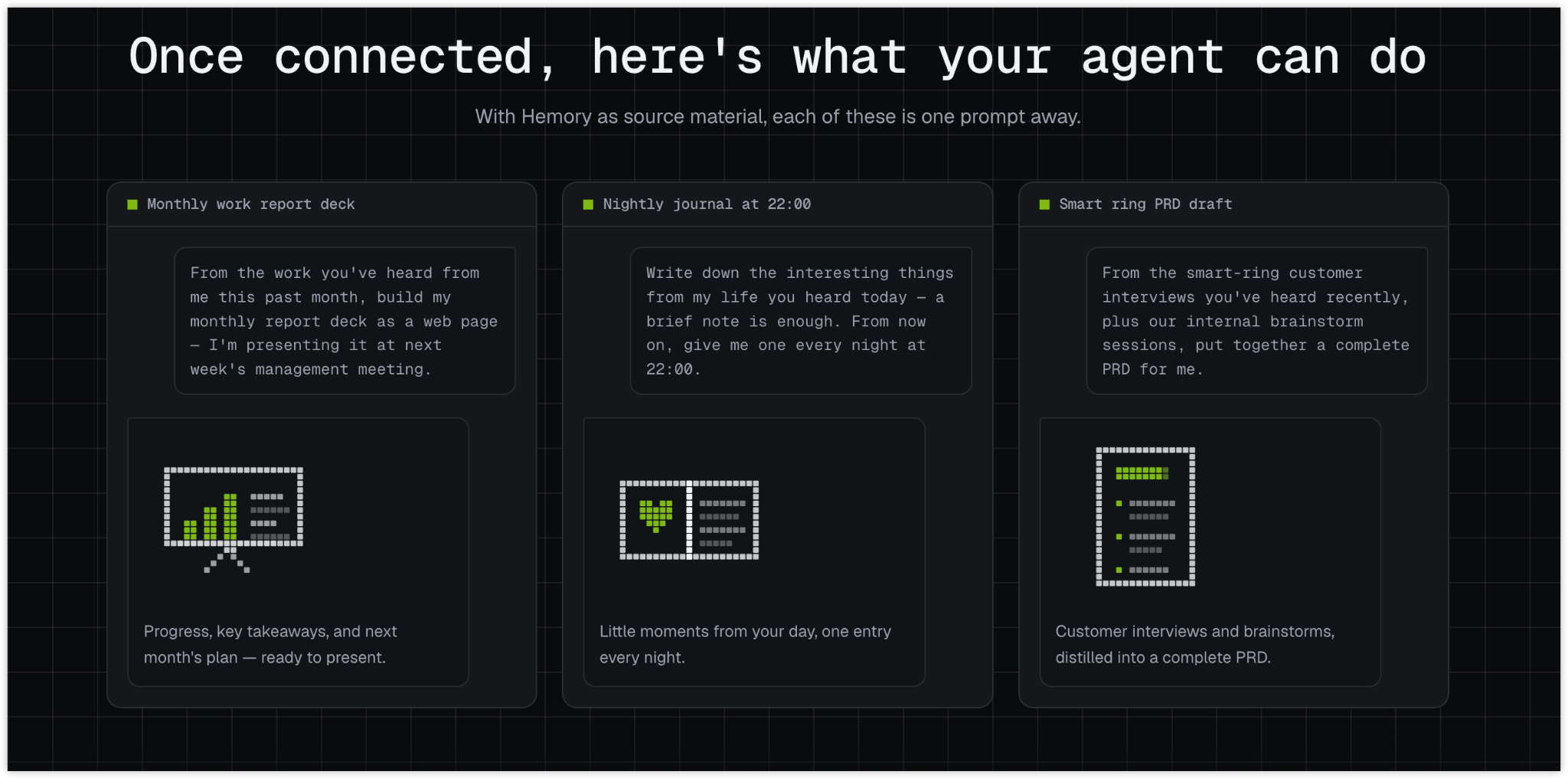
Turn saved context into reports, journals, and product requirements.
For example, a cautious draft might say:
Proposed: Restrict account exports to administrators. The discussion raised this option, but the available record does not establish approval or confirm that exports are in the first release. Open question: Should this be included in the initial scope?
This phrasing keeps the source material useful without turning a suggestion into a commitment. If a decision was accepted, preserve its conditions; if the record is unclear, identify the specific point that needs confirmation.
What this context does not guarantee
Captured conversation context is not perfect or complete by definition. Transcripts may contain errors or omissions, and retrieval is not guaranteed to find every relevant detail. Speaker labels and summaries can help orient you, but they do not prove that a decision was accepted or remains current.
For consequential requirements, review the relevant wording, attribution, conditions, and current status. Add new information—such as a changed release scope—that was not in the past discussion. If a necessary detail has no usable record, do not ask the agent to fill the gap with an assumption; consult another source or request clarification.
FAQ
Does an AI need the meeting to have happened in its chat?
No. A meeting can be a separate context source if it was captured and is accessible through a supported route. Without a record or another accessible source, the AI cannot know what was said.
Can an agent retrieve every past meeting from Hemory?
That is not guaranteed. Retrieval depends on the connected route, the agent’s access, and what was captured and found. Treat results as useful context to review, not proof that the full history has been retrieved.
Is a meeting summary enough for a requirements document?
Sometimes, but a short summary may omit wording or conditions that affect whether something was a proposal, decision, or open question. When that distinction changes the requirement, consult the accessible conversation record or confirm the point with the team.
Use the source that can support the decision
For a requirements draft, start with the current task and the decisions or conditions that could change the document. If those details were captured in Hemory and are accessible through the route you use, they can provide background beyond the chat. Review the resulting draft and resolve any material gaps before treating it as a team decision.