

 Hemory Team
On this page
A daily or weekly report often draws on discussions that happened across several conversations. An AI agent can help turn captured context into a readable draft, but retrieved conversations are not a complete record of everything that happened or proof of the current state. Here’s what the agent can reasonably draft, what Hemory contributes, and what you should confirm before sharing the report.
TL;DR
- An agent can draft a narrative from accessible, previously captured conversations, including stated work, decisions, action items, and blockers.
- Hemory can provide relevant captured conversation context through a supported connection. The external agent—not Hemory—reasons over that context and drafts the report.
- Confirm current status, outcomes, metrics, owners, deadlines, and commitments. Missing from retrieved conversations does not necessarily mean absent from the work.
What can an agent draft from past conversations?
If the relevant discussions were captured and the connected agent can access them, it can organize what people said into report-ready sections. Depending on the source material, a draft might cover:
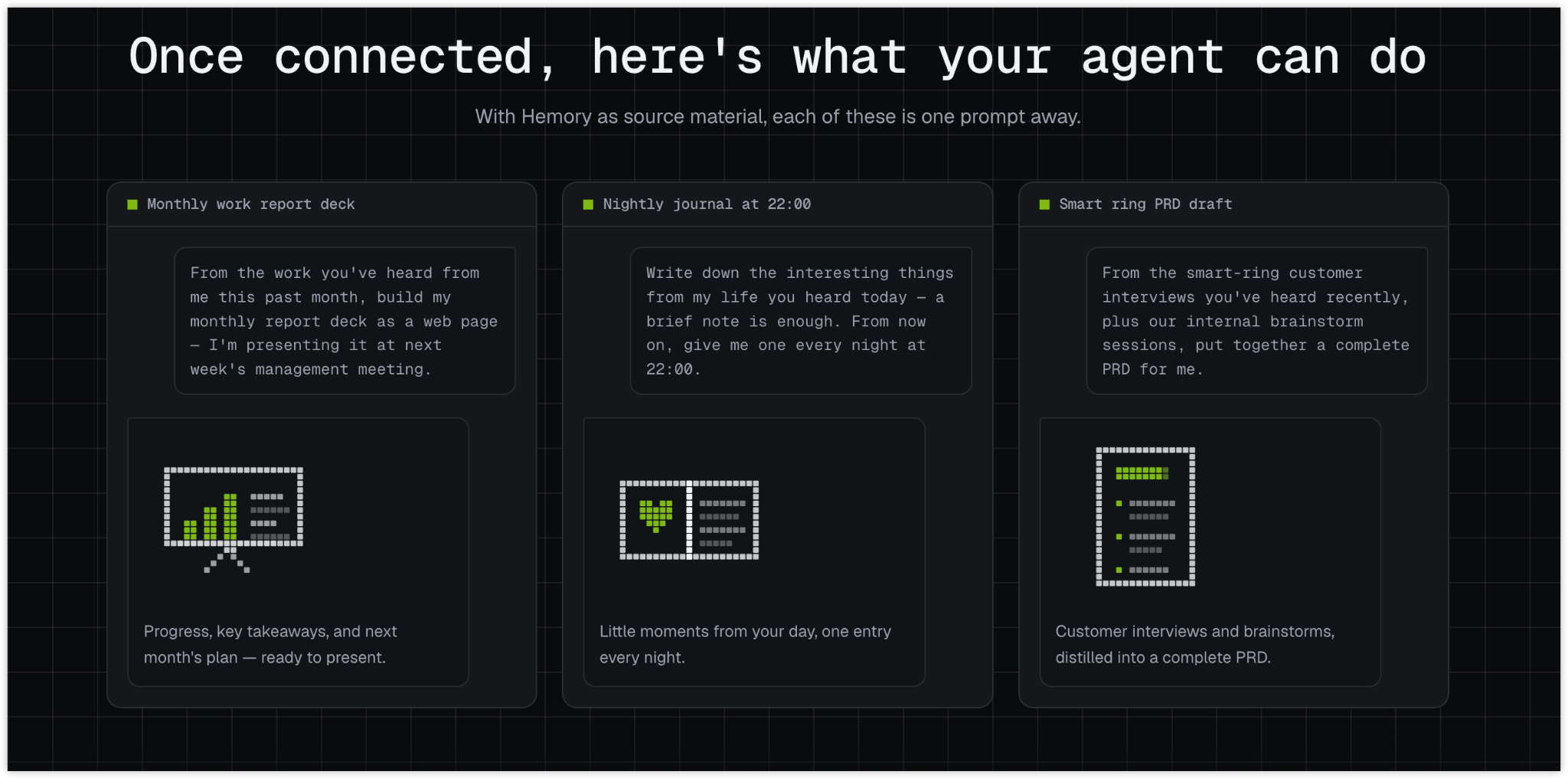
Turn saved context into reports, journals, and product requirements.
- Work discussed: progress, tasks, or topics people described.
- Decisions and rationale: choices that were actually accepted, along with the reasons stated.
- Action items: follow-ups people agreed to, with owners or deadlines only when the conversations establish them.
- Blockers and open questions: issues or dependencies that were raised and remain unresolved in the available context.
- Changes over the reporting period: how a discussion or stated plan developed across captured conversations.
These are possible draft sections, not guaranteed contents. A conversation may mention a proposal without recording that anyone accepted it. A person named in a discussion is not automatically the owner of a task, and a past commitment does not show that the work is complete. The agent should preserve those distinctions rather than turn every mention into a confirmed report item.
What does Hemory contribute?
Hemory captures and organizes conversations as searchable Memory. Its product description includes timestamped transcripts with speaker labels and AI cleanup; it also describes automatic activity classification and structured notes for meetings. The format of a meeting note should not be assumed for every work conversation.
For a report, the useful contribution is access to relevant captured discussions that might otherwise require the user to search multiple records, recall details, and retell them to an AI. A supported connected agent can use the context available to it to retrieve and draft. The agent performs the reasoning and writing; Hemory provides the conversation context. The user supplies the reporting goal and any current information, then reviews the result.

Retrieve past commitments and draft follow-up tasks.
The exact conversations an external agent can retrieve depend on its connection and permissions. Do not assume every client can search the same history or that Hemory can supply conversations that were never captured. If an important detail is absent or inaccessible, use another record or ask a focused follow-up rather than treating the gap as proof that nothing happened.
What should you confirm before sharing?
Conversation context can support a draft, but a periodic report often needs information that changes after the discussion. Review the draft for:
| Report detail | What to confirm |
|---|---|
| Reporting period | Whether the retrieved conversations cover the dates the report is meant to summarize. Coverage of the source records and the date they were last checked against the current plan are different things. |
| Current status | Whether a task is still in progress, has been completed, or has changed since it was discussed. A historical promise does not establish present progress. |
| Decisions and commitments | Whether a statement was a proposal, an accepted decision, a conditional commitment, or an unresolved question. Preserve any conditions and identify precisely what remains uncertain. |
| Owners and deadlines | Whether the person accepted responsibility and whether a deadline was actually stated. Do not fill missing fields with guesses. |
| Results and metrics | Whether figures are current and comparable, and whether the source defines their period and population. Do not infer an improvement from unlike measures. |
| Attribution and wording | Whether the right person is associated with each statement and whether the report accurately reflects what was said. Transcripts and summaries can contain omissions or errors. |
A useful review asks: “Would this statement change what a reader believes or does?” Give those claims the closest attention. You do not need to replay or inspect every source for every sentence; check the records that matter when attribution, conditions, authority, or current status could change the conclusion.
A practical report draft
For example, suppose accessible conversations contain a stated decision, a follow-up someone accepted, and a concern raised without a resolution. An agent could arrange those as:
Decisions: [State the accepted decision and its recorded rationale.]
Follow-ups: [List the agreed action; include an owner or deadline only if stated.]
Open issues: [Describe the concern and what remains unresolved in the available conversations.]
Current status: [Add a current update from an up-to-date source or ask the relevant person to confirm it.]
This structure keeps recorded discussion separate from information that still needs confirmation. If the agent cannot find a status update, the report should say that the available conversations do not establish the current status—not that the work is stalled or incomplete.
How to use the draft responsibly
Give the agent the reporting period, audience, and desired format, along with any current facts the conversations cannot establish. If the relevant discussions were previously captured in Hemory and accessible through the connection, the agent can use that context without requiring you to prepare a complete manual chronology first. Review the consequential claims, fill genuine gaps from current sources, and carry the final report into your normal review or sharing process.
Hemory does not guarantee complete retrieval or deliver the report for you. The value is that captured discussions can provide useful context for the agent’s draft, reducing the need to reconstruct and re-enter that history. Your judgment remains essential for deciding what is current, accurate, and appropriate to share.
FAQ
Can an AI agent write a complete weekly report from conversations alone?
It can draft report sections supported by the conversations it can access, but conversations alone may not establish full coverage, current status, or final outcomes. Treat the result as a draft and add or confirm information from current sources.
Does the agent know which conversations matter for the reporting period?
Only if the relevant records were captured and are accessible through the connection, and the agent can identify the period from your request or available context. State the dates you want covered; do not assume that an empty result proves no relevant discussion took place.
Do I need to summarize every conversation before asking for a draft?
No. A supported connected agent can retrieve and use accessible conversation context for the task. You still need to specify the report’s purpose and provide necessary current information, then review the draft. Connection scope and permissions depend on the client.
Can Hemory send or publish the report automatically?
This article describes Hemory as a source of conversation context, not as the report’s author or delivery system. The external agent does the drafting, and any sending or publishing depends on that agent and its environment; do not assume it happens automatically.
Start with one reporting period and a clear audience. Let the agent use accessible captured context for the draft, then confirm the facts that affect decisions before sharing it.