
How to Document a Customer Exception So Others Can Act on It
“Use the special label” tells a colleague what to do, but not what a replacement must preserve. Write the exception so the next person can use it correctly.
 Hemory Team 英文


围绕真实对话、可搜索的记忆与 AI 智能体,分享故事和实用指南。
通过 RSS 订阅 →“Use the special label” tells a colleague what to do, but not what a replacement must preserve. Write the exception so the next person can use it correctly.
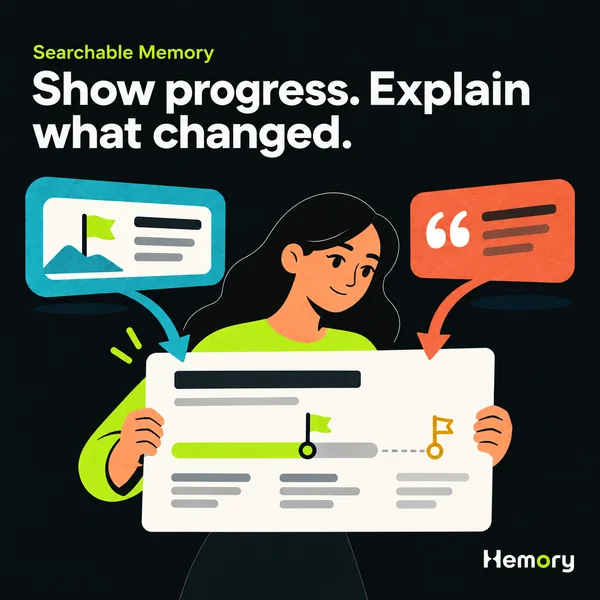
Hemory Team 英文 A confident suggestion is not always an approved change. Learn what establishes a decision, how to preserve a promise, and when later information changes the conclusion.
Hemory Team 英文 Move from a month of customer discussions to a usable requirements brief, preserving what customers said and what the team still needs to learn.
Hemory Team 英文 Keep the conversation and the next action, without turning every customer call into a full writing task.
Hemory Team 英文 Understand which retrieval clues help with your question, and why finding a passage is different from knowing what it establishes.
Hemory Team 英文 A reminder tells you when to reconnect. The earlier discussion may explain what to say. Choose the combination that fills the gaps in your client records.
Hemory Team 英文 Email search and conversation memory cover different parts of the commitment landscape. Compare their coverage, nuance, traceability, and recency, and learn when to use each.
Hemory Team 英文 An approval message may not explain the choice. Learn when to search work chats, when to return to a captured discussion, and how the two records fit together.
Hemory Team 英文 A wiki entry should explain the current instruction without making readers reconstruct the meeting. Use the spoken background to fill the gaps that affect work.
Hemory Team 英文 A positive response can open the next conversation without settling the purchase. Recover what the client actually agreed to before planning the next step.
Hemory Team 英文 Arrive at the next client call knowing what each side agreed to do, what has changed, and which questions still need an answer.
Hemory Team 英文 The client expects delivery on Friday; you remember a deadline tied to their data. Recover the context and agree on what happens next.
Hemory Team 英文 Keep the next client call moving. Use earlier decisions and their reasons to prepare focused questions, with a talking-points template and worked example.
Hemory Team 英文 A covering colleague needs more than a task list. Give them the reasons, conditions, and open questions they need to handle the next client request.
Hemory Team 英文 Share what you have found and ask about the specific gap. A useful clarification can locate a source, explain a reference, or reveal a later decision.
Hemory Team 英文 Give AI the discussion background a task actually needs. Retrieve and draft a brief together, then keep the conditions that shape the final output.
Hemory Team 英文 Your task record shows what is done; project discussions explain why plans changed. Bring both into a status update that makes progress, dependencies, and next steps clear.
Hemory Team 英文 Bring ideas, customer needs, and decisions from real-world conversations into your AI workflow, with less note-taking, summarizing, and copying by hand.
Hemory Team 英文 Write a meeting follow-up email with templates for teams, clients, and unresolved decisions, plus subject lines and an example grounded in a discussion.
Hemory Team 英文 Copy a decision log template with essential fields, a completed example, and a simple way to track changes and find the reasoning behind past decisions.
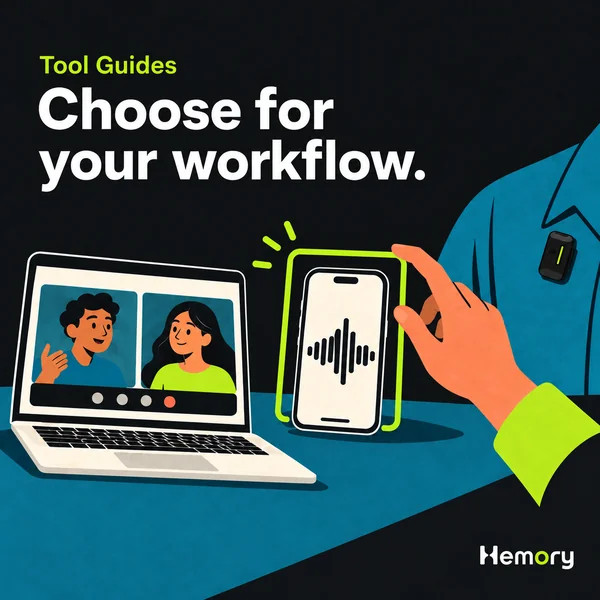
Hemory Team 英文 Choose an AI note taker for your meetings and follow-up work. Compare capture, accuracy, search, integrations, privacy, and the manual work still required.
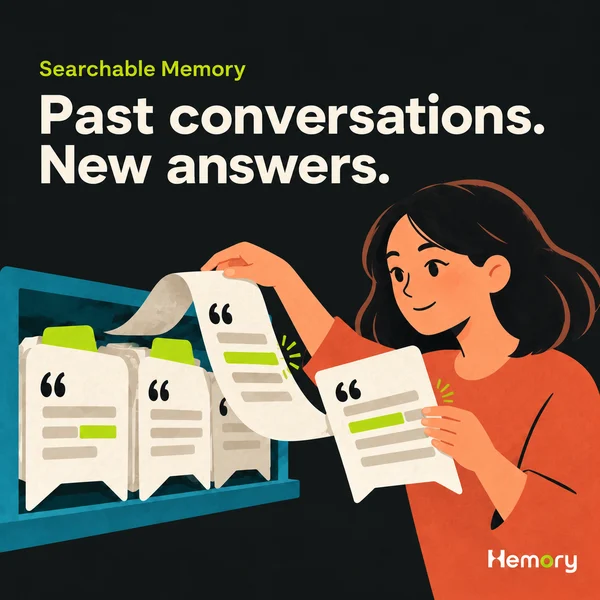
Hemory Team 英文 Turn real-world conversations into searchable memory with Hemory. Revisit details, connect discussions, and use past context to answer new questions.
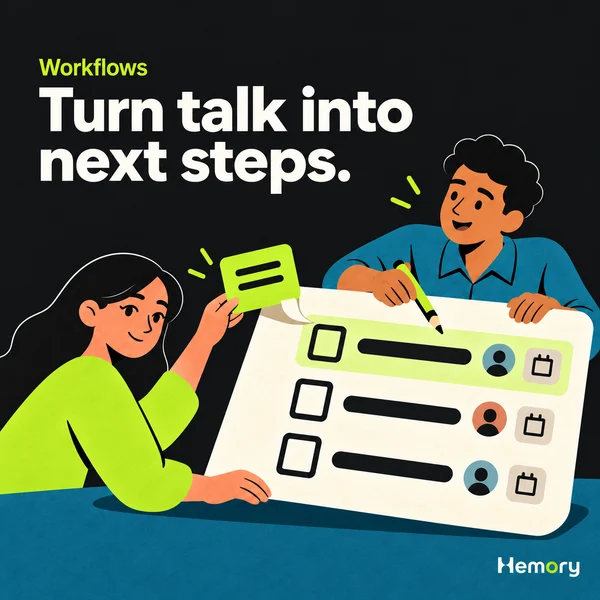
Hemory Team 英文 Turn meetings into a to-do list with Hemory. Review action items, owners, deadlines, and the conversation behind each task.
Hemory Team 英文 Hemory 取自 Hear and Memory。不是会议语音转写,而是一个能记录所有对话、自动存成记忆的工具。通过 AI Agent 对话,回顾记忆并进行下一步的加工。
下载 Hemory,让今天起每一段真实的对话,都变成明天可以生成的材料。
macOS、Windows、Linux、Web、自部署即将推出
我们使用 X 的广告 cookie 衡量广告带来的访问。仅在你同意后才会加载——拒绝则不设置任何内容。 隐私政策










 @wangyingqi