 Hemory Team
On this page
You are preparing a client handoff when someone asks why the team ruled out a particular approach. The project plan records the choice, but the explanation came up in a discussion you can no longer locate. Before you can finish the handoff, you have to find someone who remembers.
The cost extends beyond searching. Missing conversation context can interrupt colleagues, lead to repeated work, and hold up decisions. Here is how to recognize those costs, distinguish them from useful follow-up, and decide where a searchable record would help.
TL;DR
- Count the work of finding and reconstructing context, including the time other people spend helping.
- Separate avoidable rework from a valid reassessment prompted by new information.
- Track delays separately from working time; a task waiting overnight is not eight hours of labor.
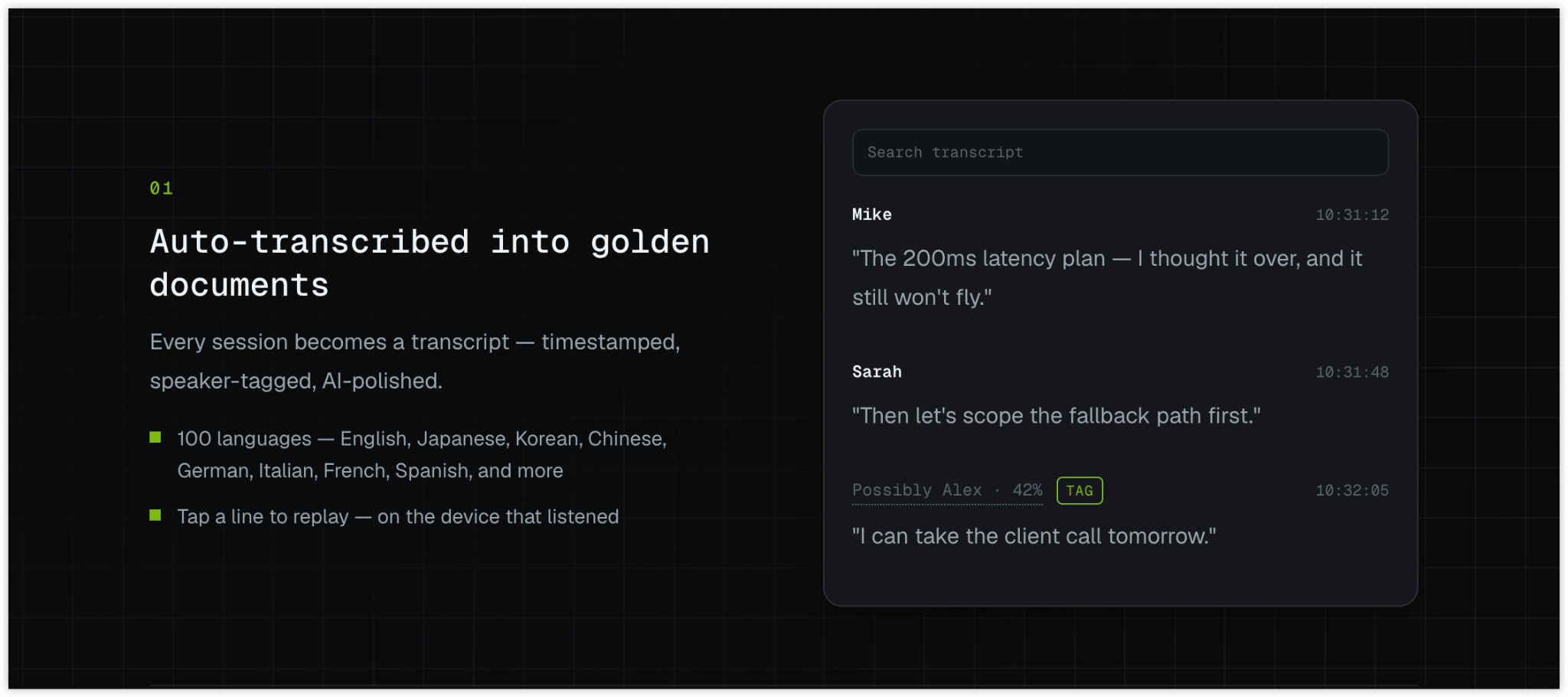
- Hemory captures and organizes spoken discussions so you can return to their details when later work needs them.
When a conversation is hard to find
A work conversation does not have to disappear completely to become difficult to use. The outcome may be in a document, the reasoning in a recorded meeting, and a later qualification in a different exchange.
Text messages may already be searchable. The harder problem is finding the right discussion and enough of its context to answer your question. Spoken conversations can leave an even larger gap if nobody records or documents them.
Before changing tools or habits, identify which situation you face:
| What is missing? | What that means | What would help? |
|---|---|---|
| A detail that was never recorded | There is no saved source to retrieve | Capture suitable future discussions or document the important outcome |
| A detail buried in saved conversations | The information exists but is difficult to locate | Searchable records with useful topic, date, or speaker context |
| The current agreement | Earlier discussions exist, but the latest position is unclear | An updated working document or decision record |
| A decision nobody made | The conversation left a question unresolved | A new discussion or an explicit decision |
Search helps with the second situation. Hemory also addresses the first by listening to and organizing conversations you choose to capture. Keeping the current plan up to date and resolving open questions remain part of the work.
Four costs that can hide inside everyday work
1. Time spent reconstructing context
Opening several meeting notes, searching different phrases, and comparing fragments can become a task of its own. Finding a sentence may still leave you unsure which project it concerned or whether someone revised it later.
For example, a note saying “customer needs training” leaves a consultant to reconstruct the audience, format, and topics before preparing a session. The work lost here is the effort of recovering information already discussed.
A useful sign is that preparation repeatedly starts with “What did we say about this?” rather than the work you intended to do. Notice where that happens: proposals, handoffs, project updates, or returning to a paused assignment.
2. Interruptions for the people who remember
When a record is difficult to find, asking a colleague is often the quickest option. But the colleague must then locate or reconstruct the same context.
This can concentrate extra work on a project lead, account owner, or experienced teammate. A question that takes you a minute to send may require them to reopen files or revisit an old discussion before answering.
Distinguish a request for an existing fact from a request for judgment. “Which reporting format did the client ask for?” may be answered by a saved conversation. “Does that format still make sense after the scope changed?” may deserve a fresh discussion. The second question can be valuable even when the record is easy to find.
3. Rework caused by losing the reason behind a choice
An outcome without its reasoning can look arbitrary. Someone may repeat an earlier investigation, recreate an option that was already rejected, or prepare work that overlooks a known constraint.
Suppose a team chose a manual review because a customer’s data lacked a field needed for automation. A later handoff says only “manual review.” A new colleague may spend time designing an automated route before rediscovering the missing field.
The important distinction is whether the evidence changed. If the customer now supplies that field, reconsidering automation is useful. If nothing changed and the original constraint was simply hard to recover, the repeated investigation was avoidable.
A concise decision log can preserve the choice and its reason. The saved discussion provides more detail when a later question goes beyond that short entry.
4. Delays while work waits for an answer
Missing context can hold up work even when the effort of answering is small. A colleague may be in another time zone, away from the project, or busy with a deadline.
A handoff might wait for someone to explain a customer condition. A draft might sit unfinished until the author can confirm what was promised. The delay matters when it affects another task or an external commitment.
A conversation with the incoming owner is not inherently wasteful. It can build understanding and surface new questions. The avoidable part is waiting for basic background that could have been available before that conversation.
Estimate the cost without turning it into another project
For a normal working week, keep a short note when missing conversation context gets in the way. You do not need to record every search. Focus on cases that interrupt work, involve someone else, or lead to a repeated task.
| Situation | Effort to note | Delay to note separately | Question to ask |
|---|---|---|---|
| Looking for an earlier requirement | Time spent locating and reconstructing it | Whether preparation had to wait | Was the detail captured, and could I locate it? |
| Asking a colleague to repeat context | Your search time and their time answering | How long the task waited for a reply | Did I need a fact or a new judgment? |
| Repeating an investigation | Work repeated because the earlier finding was unavailable | Any effect on the next task | Had the underlying facts changed? |
| Preparing a handoff | Extra work assembling missing background | When the handoff could actually proceed | What should the incoming owner have been able to read first? |
Add active effort once. If you spend ten minutes searching and a colleague spends five minutes helping, that is fifteen person-minutes. If you also wait two hours for the reply, record that waiting time separately. It is not another two hours of work.
The same incident may involve search, interruption, and rework. Break out the actual activities rather than counting the whole incident in every category. Avoid converting every delay into lost revenue unless you have evidence connecting the delay to that outcome.
At the end of the week, look for the recurring task with the clearest consequence. A repeated difficulty recovering customer requirements may be a better starting point than a broad ambition to make every conversation searchable.
Reduce the cost at the point where it starts
The best change depends on what caused the gap. If the answer is already in a current document, improve how people find that document. If the discussion never reached a record, better search alone will not recover it.
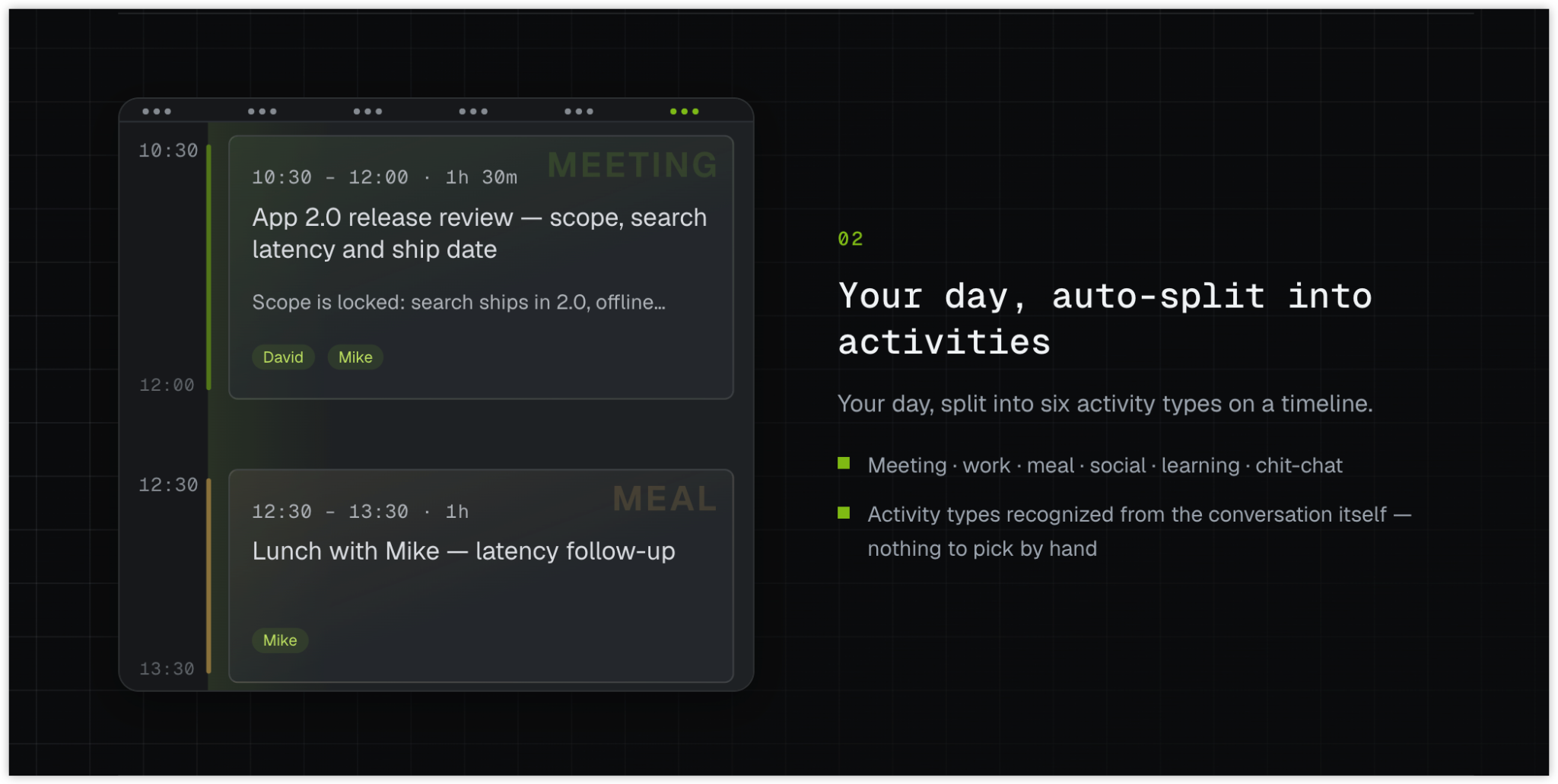
For spoken work, you can use Hemory to listen to appropriate discussions with participants’ agreement. Hemory organizes the captured material into transcripts and summaries. That reduces the need to divide your attention between participating and deciding which details to write down for later.
Consider a consultant preparing a handoff after several customer workshops. During the workshops, the consultant needs to explore requirements and ask follow-up questions. Using Hemory to listen during those discussions leaves material to return to when writing the handoff, including details that did not seem important enough to note at the time.
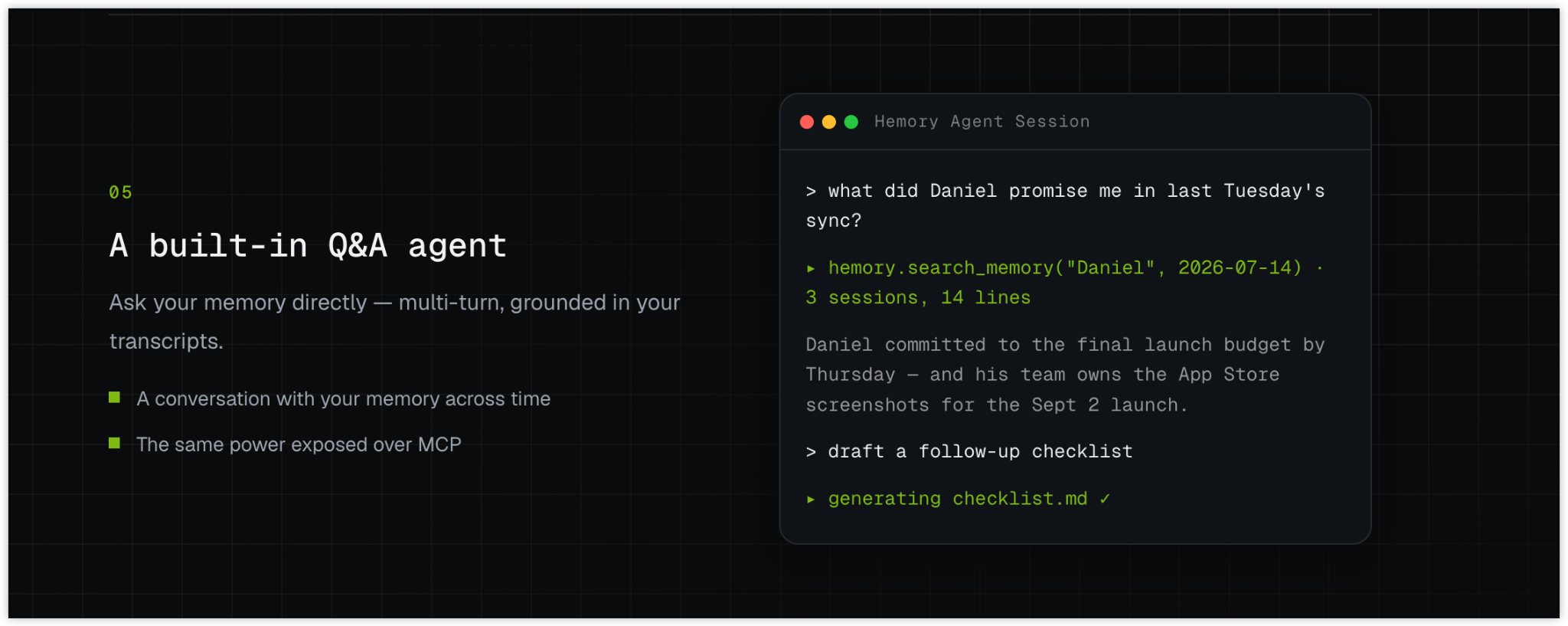
Hemory can also make captured conversation context available to a connected AI agent through its MCP Server. The agent can use that context when helping draft a handoff; you still need to review the sources and the result.
For example, the consultant can ask the connected agent:
In the customer workshops about invoice review, why did we choose a manual check, and what would need to change before we could automate it?
The aim is to recover the constraint and the condition for revisiting the choice. Those details let the consultant explain the current approach and give the incoming owner a useful next question. Without the saved discussions, that background would need to come from scattered notes, memory, or another round of questions.
Use the retrieved context to update the handoff or current plan. Keep the background accessible for later questions, while making the agreed next step clear in the document people will use. Hemory supports your own captured conversation history; the handoff is still the material you choose to share with the next person.
For more ways to reuse recorded discussions, see the guide to searchable conversation memory.
Decide whether the change is helping
Try the approach on one recurring piece of work, such as preparing a customer follow-up or revisiting a design choice. Compare the effort required with your usual process:
- Can you find the requirement or explanation needed to proceed?
- Do you spend less time reconstructing background or asking someone to repeat it?
- Does the resulting brief or handoff preserve the details that matter?
- How much effort remains in reviewing the result and maintaining the current record?
The useful outcome is a piece of work you can complete with less reconstruction. Include the work of recording, reviewing, and using the material when assessing the benefit. A searchable archive is valuable when it makes the next task easier.
If the recurring problem is an unclear owner, a decision that was never made, or an outdated plan, address that directly. More recordings will not resolve it on their own.
Frequently asked questions
Is this a search problem or a documentation problem?
It can be either. If the information was captured but is hard to locate, retrieval is the issue. If nobody recorded the explanation, capture is the issue. If people can find an old agreement but do not know what applies now, the working record needs updating. Identifying the gap helps you choose a useful change.
Does every conversation need to be recorded?
No. Start with discussions whose details are likely to inform later work, such as customer workshops, planning conversations, or technical trade-offs. Record where appropriate and agreed by the participants. Routine coordination may be adequately covered by a short note or an existing task update.
Does a searchable record replace a handoff meeting?
No. It can reduce the time spent repeating background and help the incoming owner prepare better questions. Use the meeting for interpretation, priorities, and unresolved issues, with the relevant record available beforehand.
Start with one question you keep having to ask again
Choose a discussion that will feed into a later deliverable. Use Hemory to capture it while you participate, then return with the question that deliverable actually requires. Judge the result by whether you can move the work forward with less time spent rebuilding the background.